---
title: "Quality Consistency in Automated Sewing: Oeko-Tex vs GOTS"
url: https://cogarm.com/automated-sewing-quality-consistency-metrics-oeko-tex-vs-gots/
date: 2026-05-31
modified: 2026-09-09
lang: en
author: "allan hill"
description: "The Role of Automated Sewing in Quality Consistency In the competitive landscape of modern manufacturing, consistency is the cornerstone of brand reputation. For apparel and textile producers, achieving uniform stitch..."
categories:
  - "Manufacturing & Capabilities"
tags:
  - "automated sewing"
  - "production standards"
  - "quality consistency"
  - "sewing automation"
  - "textile manufacturing"
image: https://cogarm.com/wp-content/uploads/2026/05/qc-inspector-verifying-seam-specs-with-o.jpg
word_count: 1518
---

# Quality Consistency in Automated Sewing: Oeko-Tex vs GOTS

## The Role of Automated Sewing in Quality Consistency

In the competitive landscape of modern manufacturing, consistency is the cornerstone of brand reputation. For apparel and textile producers, achieving uniform stitch quality, precise seam alignment, and repeatable output across thousands of units has historically been a labor-intensive challenge. Automated sewing technology is now redefining this standard, offering a direct path to predictable, high-quality production.

## Eliminating Human Variability

![Related image for The Role of Automated Sewing in Quality Consistency](https://cogarm.com/wp-content/uploads/2026/05/automated-sewing-quality-consistency-metrics-oeko-tex-vs-gots.jpg)

(See our related guide: [Minimizing Waste in High-Volume Garment Manufacturing](https://cogarm.com/minimizing-waste-in-garment-manufacturing-knit-vs-woven-data/).)

Manual sewing relies heavily on operator skill, fatigue levels, and attention to detail. Even the most experienced sewers produce slight variations in stitch density, tension, and seam allowance over a long production run. Automated sewing systems, equipped with servo-driven needle positioning and real-time tension control, eliminate this variability. Each stitch is executed with the same force, speed, and depth as the last, ensuring that the 1,000th unit matches the first.

## Precision Through Sensor Feedback

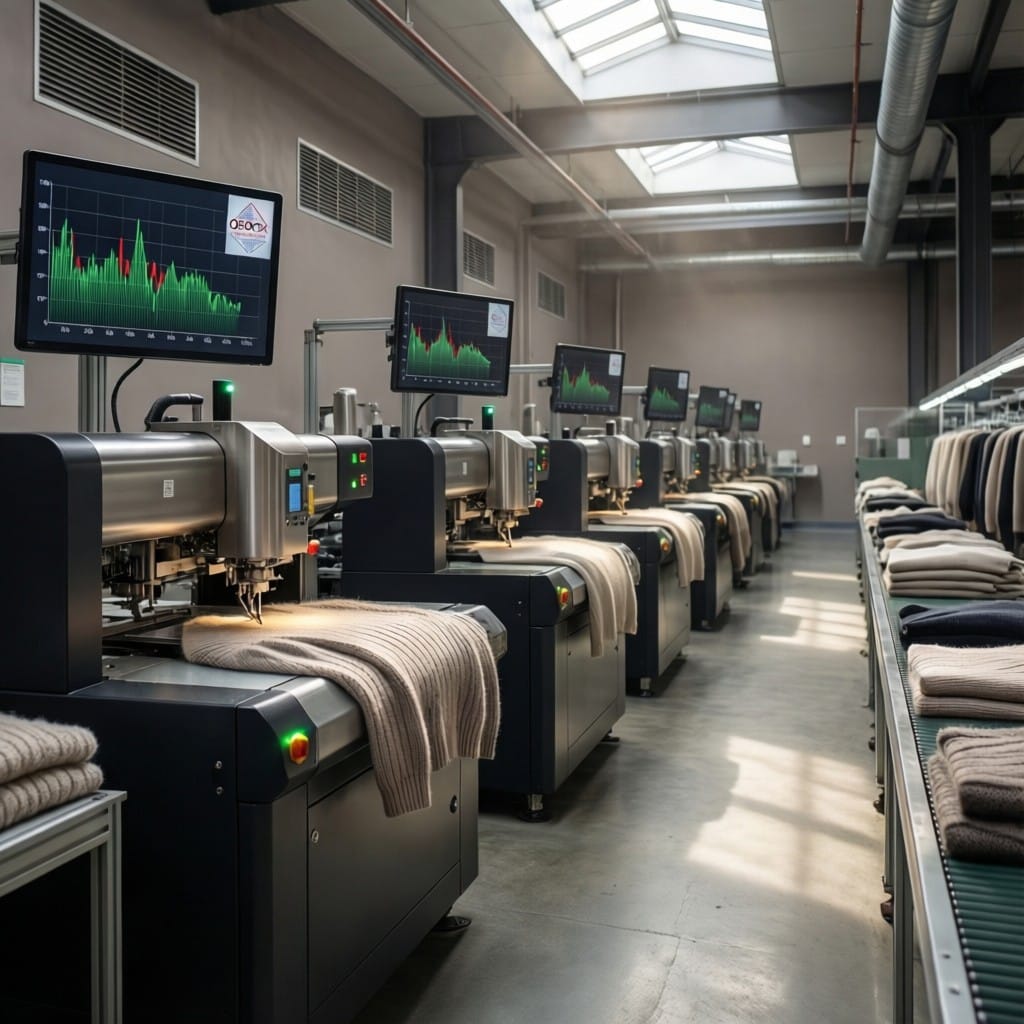
Modern automated sewing machines integrate optical sensors and laser-guided alignment systems. These components continuously monitor fabric feed, edge detection, and thread tension. If a deviation is detected—such as a fabric shift or thread break—the system adjusts parameters in milliseconds or halts production to prevent defects. This closed-loop feedback mechanism is impossible to replicate with manual oversight, directly reducing rework and scrap rates.

## Repeatability Across Production Runs

One of the greatest advantages of automation is the ability to store and recall exact sewing parameters. A specific seam type, stitch length, or hem profile can be programmed once and replicated identically across different shifts, factories, or even years. This repeatability is critical for brands that require consistent quality across seasonal collections or multiple manufacturing sites. Automated systems ensure that the “golden sample” standard is maintained without relying on institutional knowledge or operator memory.

[Read more about How Laser Cutting Improves Acc](https://cogarm.com/laser-cutting-in-garment-manufacturing-01mm-precision-vs-dies/) for additional context.

## Reducing Defects and Rework

Common sewing defects—such as puckering, skipped stitches, or uneven seam allowances—are often the result of inconsistent manual handling. Automated sewing minimizes these issues by controlling fabric feeding with precision rollers and maintaining constant thread tension. The result is a dramatic reduction in defect rates. For high-volume operations, this translates directly into lower inspection costs, less fabric waste, and faster throughput without sacrificing quality.
![Related image for The Role of Automated Sewing in Quality Consistency](https://cogarm.com/wp-content/uploads/2026/05/automated-sewing-line-producing-merino-w.jpg)

## Data-Driven Quality Monitoring

Automated sewing machines generate valuable production data. Metrics such as stitches per minute, tension variance, and machine downtime can be analyzed to identify quality trends. This data allows quality managers to spot potential issues before they become systemic, adjusting machine settings or maintenance schedules proactively. In a manual environment, such insights are anecdotal at best; with automation, they become actionable intelligence.

— as detailed in our article on [Understanding Garment Grading for Global Markets](https://cogarm.com/garment-grading-rules-knit-vs-woven-tolerances-benchmarks/).

## Scalability Without Quality Trade-offs

As production volumes increase, maintaining quality consistency becomes exponentially harder with manual labor. Automated sewing scales seamlessly. Adding more automated workstations does not dilute quality—each unit operates to the same programmed standard. This scalability is essential for brands expanding into new markets or responding to seasonal demand spikes without compromising the product integrity that customers expect.

## Automated Sewing for Quality Consistency

Automated sewing is not merely a tool for increasing speed; it is a strategic investment in quality consistency. By removing human variability, enabling precision feedback, and providing data-driven oversight, automation ensures that every garment meets the same high standard. For manufacturers committed to delivering reliable, repeatable quality, automated sewing is no longer optional—it is essential.

For a deeper dive, see [How Knit and Woven Integration Changes Apparel Design](https://cogarm.com/knit-woven-integration-apparel-design-revolution/).

## Frequently Asked Questions

### How is quality inspection handled?

AQL 2.5 inspection standard applied. Third-party inspection (SGS, Intertek) available upon request at buyer’s cost. Inline inspections during production with photo reports.

### What compliance certifications are available?

The supplier supports OEKO-TEX Standard 100, GOTS (organic cotton), GRS (Global Recycled Standard), and BSCI audits. Certification costs are borne by the buyer; we facilitate the process.

### What is the sample lead time?

Sample production takes 15-20 days. If sourced yarn is required, add 5-7 days for yarn procurement. Samples are charged at 1.5x unit price, refundable upon bulk order confirmation.

### What is the bulk production lead time?

Bulk production runs 45-60 days from sample approval. Rush orders (20-30 days) available for repeat clients with confirmed yarn stocks.

### What is the minimum order quantity (MOQ)?

MOQ is 100 pieces per color/style for knitwear and 200 pieces for woven garments. Stock yarn options allow smaller trial orders.

## Aligning Automated Sewing Metrics with GOTS and OEKO-TEX Compliance

While automated sewing guarantees mechanical consistency, procurement managers must understand how this precision intersects with chemical and organic integrity standards. The distinction between OEKO-TEX Standard 100 and Global Organic Textile Standard (GOTS) fundamentally alters how automated parameters are validated during knitwear assembly. OEKO-TEX focuses exclusively on finished product safety, meaning automated sewing consistency is judged solely by physical defect rates and the absence of restricted substances in the final garment. In contrast, GOTS mandates chain-of-custody integrity throughout processing. For a Dongguan knitwear manufacturer, this means automated sewing lines dedicated to GOTS orders require strict physical segregation and documented cleaning protocols to prevent commingling with conventional synthetic yarns.

When evaluating quality consistency through a compliance lens, buyers should request specific technical documentation that bridges automation data with certification requirements:

- **GOTS Segregation Logs:** Verification that automated sewing stations were flushed of non-organic fibers and lubricants before organic production runs, ensuring no cross-contamination at the needle point.

- **Lubricant Safety Data Sheets (SDS):** Confirmation that all machine oils and silicone-based thread lubricants used in automated feeders are GOTS-approved input chemicals, not just OEKO-TEX compliant.

- **Needle Heat Monitoring Records:** Data showing temperature thresholds maintained below levels that could degrade organic cotton fibers or cause thermal damage to recycled polyester blends.

- **Tension Variance Reports by Certification Type:** Comparative analysis demonstrating whether organic yarns (which often have lower tensile strength) required recalibrated tension settings versus conventional counterparts to maintain identical seam appearance.

## Technical Vetting Criteria for Automated Knitwear Assembly

Sourcing managers frequently encounter discrepancies between factory claims of "fully automated" production and actual floor capabilities. True automated sewing in knitwear differs significantly from woven garment automation due to fabric stretch recovery and edge curling. When vetting suppliers for quality consistency, move beyond generic capability questions and demand evidence of knit-specific automation infrastructure. Ask specifically about programmable clamp systems designed for jersey or rib structures, as standard clamps often distort knit edges, causing irreversible skewing that mimics human error but originates from improper tooling.

Additionally, inquire about the integration of automated sewing units with upstream knitting operations. A manufacturer utilizing separate cutting and sewing departments without digital linkage cannot guarantee lot-level consistency. Request batch traceability reports that correlate specific knitting machine outputs with corresponding automated sewing station IDs. This granular tracking is essential for isolating root causes when AQL inspections reveal systematic defects. If a supplier cannot provide machine-level production data linking knitting batches to sewing output, their claim of automated quality consistency likely relies on post-production sorting rather than process control. Finally, verify that automated pressing and finishing equipment is calibrated specifically for the gauge and composition of your knitwear; inconsistent steam pressure or platen temperature can negate the precision achieved during automated assembly, particularly for fine-gauge merino or cashmere blends where fiber memory is sensitive to thermal variation.

## Cost and Lead Time Implications of Certified Automated Production

Integrating automated sewing with dual-certification capability introduces measurable variables into procurement planning. Buyers should anticipate a 7–10% premium for GOTS-compliant automated runs compared to OEKO-TEX-only production, primarily driven by changeover downtime, certified input chemical costs, and additional segregation labor. Lead times for initial automated GOTS orders typically extend 5–7 days beyond standard schedules as factories validate new parameter sets for organic yarn behavior under servo-controlled tension.

However, repeat orders on established automated lines often achieve parity with conventional lead times once baseline parameters are locked. The critical cost consideration is sampling: requesting pre-production samples on automated GOTS lines requires full setup calibration, making sample charges non-negotiable and lead times longer than manual sampling. Procurement teams should budget for this upfront validation phase as a necessary investment in bulk consistency rather than an optional expense. Negotiating amortization of setup costs across multiple seasonal drops can improve unit economics while maintaining the quality assurance benefits of dedicated automated workflows.

## Frequently Asked Questions

### How does automated sewing improve quality consistency in garment manufacturing?

Automated sewing improves quality consistency by eliminating human variability through servo-driven needle positioning and real-time tension control, ensuring each stitch is identical in force, speed, and depth across thousands of units.

### What are the main sources of inconsistency in manual garment sewing?

Inconsistencies in manual sewing arise from variations in operator skill, fatigue, and attention to detail, leading to differences in stitch density, tension, and seam alignment over time.

### How do sensors enhance precision in automated sewing machines?

Sensors such as optical and laser-guided systems provide real-time feedback to ensure precise seam alignment and accurate fabric positioning, significantly improving stitching accuracy and consistency.

### Why is quality consistency important for apparel brands?

Quality consistency is crucial for maintaining brand reputation, as it ensures that every garment meets the same high standards, fostering customer trust and reducing returns or complaints.