

This article examines how transparent production logs mitigate supply chain risk, improve quality control, and streamline lead times in modern garment manufacturing. Sourcing managers and procurement specialists will discover how data-driven tracking replaces guesswork, enabling precise oversight from raw yarn selection to final shipment.
The modern apparel landscape is undergoing a structural shift driven by hyper-informed consumers and volatile market demands. Tech-forward Leading precision manufacturers have set a new standard for supply chain transparency, demonstrating that visibility is no longer a luxury but an operational imperative. In the apparel sector, brands like Patagonia and IKEA have proven that showing the “how” behind the “what” builds enduring customer equity and insulates operations against supply chain disruptions.
For procurement managers navigating apparel production, the traditional “black box” model of sourcing is a critical vulnerability. When a brand places an order, the period between deposit payment and final delivery is often characterized by a complete lack of operational visibility. A delay in yarn spinning, a dyeing bottleneck, or a failure in knitting tension can remain hidden until the shipment arrives late—or worse, fails quality standards upon arrival.
(See our related guide: How to Scale Production without Sacrificing Quality.)
This article outlines how integrating transparent, real-time production logs into your sourcing strategy eliminates these blind spots. You will learn how to evaluate a manufacturer’s logging systems, compare manual tracking against digital tracking across critical performance metrics, and leverage data to secure a predictable, high-yield apparel program.
Relevant Standards or Specifications
In precision garment manufacturing, quality is defined by measurable physical properties rather than subjective descriptions. A robust production log must track raw material inputs against standardized baselines. For knitwear, this begins with yarn diameter and gauge control. For example, when sourcing wool, fiber thickness must be verified: superfine Merino wool must measure \le 18.5µm, fine Merino \le 20µm, and medium Merino \le 22µm, while Grade A cashmere requires a diameter of \le 15.5µm to ensure compliance with premium softness and durability benchmarks.
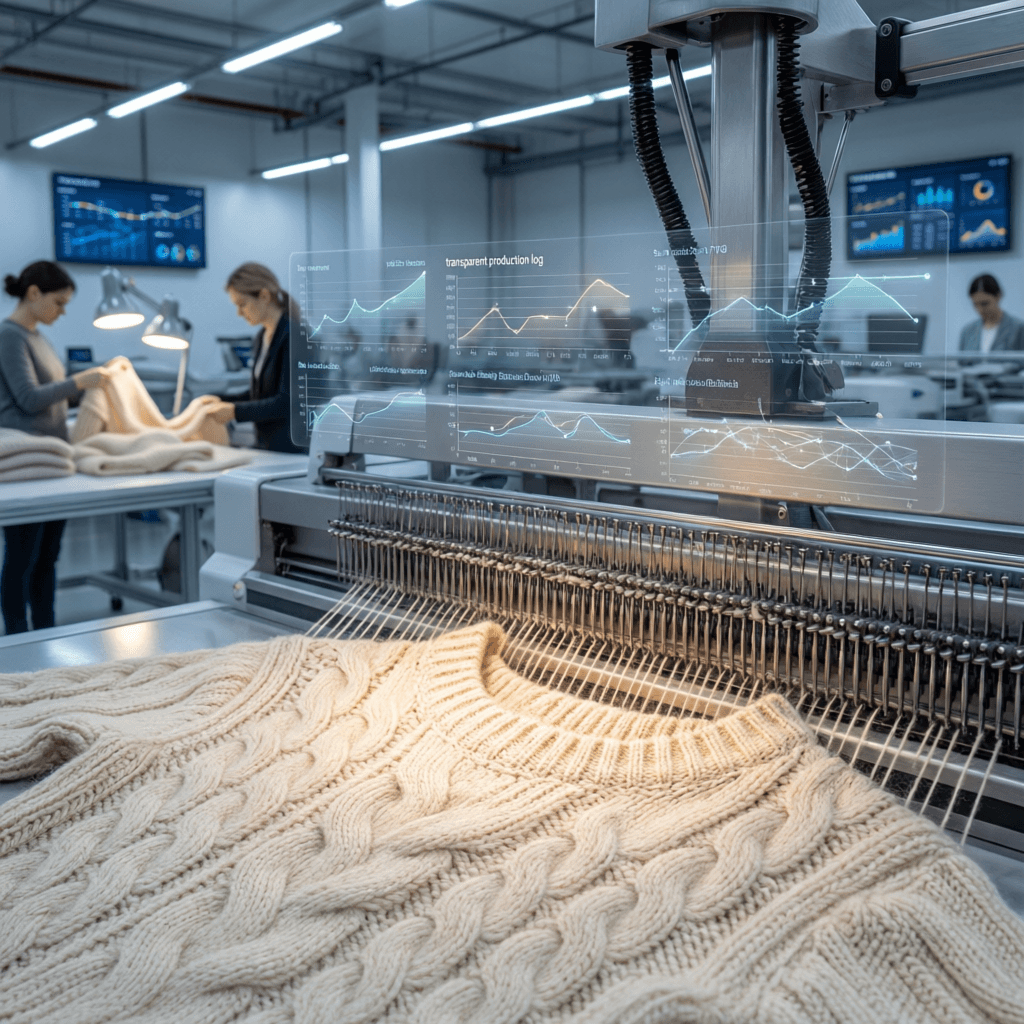
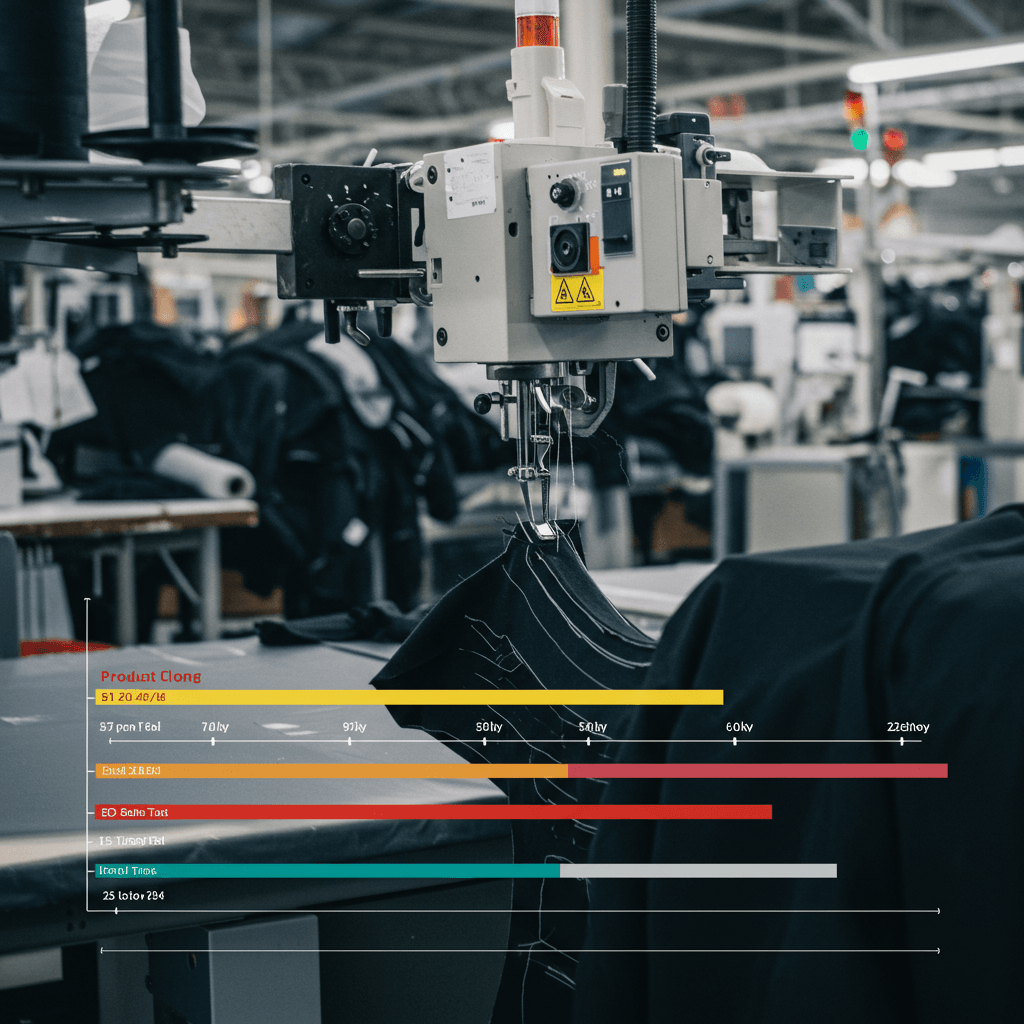
Furthermore, the production log must document machine configurations and tolerances. Knitwear tension and structure are governed by needle spacing, or gauge, which spans from 3GG to 18GG. A transparent log verifies that 3-5GG machines are calibrated for heavy, chunky knit styles, 7-10GG for midweight sweaters, and 12-18GG for fine-gauge, high-density garments. Quality assurance steps, such as checking stitch-per-inch (SPI) consistency and performing pull tests on seams, must be logged under Acceptable Quality Limit (AQL) 2.5 standards to ensure that defects do not slip through to the shipping stage.
Read more about Streamlining Communication for for additional context.
Comparison Table
To understand the operational impact of transparency, procurement managers must compare traditional manual tracking (spreadsheets, weekly emails) against digital-first, real-time production logs. Manual tracking relies on self-reporting, which introduces a structural delay and a high margin of human error. Digital-first tracking integrates machine data, IoT sensors, and centralized ERP systems to provide instant verification of production milestones.
The table below compares these two methodologies across eight critical, measurable operational metrics. This comparison illustrates how the choice of tracking system directly affects lead times, defect rates, and supply chain responsiveness.
| Performance Metric | Traditional Manual Tracking | Digital-First Real-Time Logs |
|---|---|---|
| Data Update Latency | 24 to 72 hours (self-reported) | < 1 hour (real-time API sync) |
| Yarn Traceability Error Rate | 5.0% to 12.0% allocation error | < 0.2% via RFID & barcode tracking |
| Dye Lot Consistency (Delta E) | \le 1.5 variance (re-dye rate 8%) | \le 0.8 variance (re-dye rate < 1.5%) |
| Defect Detection Point | Final AQL 2.5 inspection (End-of-Line) | In-line monitoring (at 3GG-18GG station) |
| Sample Stage Lead Time | 25 to 30 days | 15 to 20 days (+ 5-7 days for sourced yarn) |
| Mass Production Lead Time | 60 to 75 days | 45 to 60 days from sample approval |
| Color Matching Accuracy | \pm 2.0% deviation from physical swatch | 100% Pantone TCX digital spectral matching |
| Capacity Utilization Accuracy | \pm 15% planned vs. actual output | \pm 2% real-time line balancing |
The data demonstrates that digital-first production logs do not merely provide peace of mind; they directly compress the production cycle. By catching color deviations under Pantone TCX matching early in the dye vat, or detecting tension drift on a 12GG knitting machine before thousands of panels are run, digital logging reduces mass production lead times from a volatile 75 days down to a predictable 45 to 60 days.
Product Use Cases and Material Configurations
Applying these rigorous logging standards to specific product categories reveals how data-driven manufacturing protects brand integrity. Consider a premium retail brand launching a winter collection of custom sweaters. Utilizing a yarn blend of Merino wool (17-24µm) and acrylic requires strict control over moisture content and fiber tension during the spinning and knitting phases. A transparent production log records the exact blending ratio and tension settings on 12GG fine-gauge machines, preventing the uneven shrinkage or pilling that often plagues unmonitored wool-acrylic blends.
Similarly, for high-performance woven garments, tracking critical physical dimensions and seam strength is vital. When a buyer places an order with a minimum order quantity (MOQ) of 100 pieces per color/style for knitwear or 200 pieces for woven garments, a digital log tracks each batch through cutting, sewing, and pressing. Using specialized machinery, the factory logs the exact temperature and pressure applied during interlining fusing, ensuring that the woven structures do not delaminate after laundering. This level of detail is indispensable for imports destined for strict regulatory markets.
— as detailed in our article on Our Approach to Collaborative Product Development.
Supplier Solution
Advanced manufacturing partners leverage dual-base operations to provide both high-volume efficiency and specialized craftsmanship. Forward-thinking suppliers like Cogarm operate dual manufacturing bases in Dongguan, utilizing a dedicated Humen facility for cut-and-sew woven garments and a specialized Dalang facility for premium knitwear. This structural separation allows each facility to optimize its logging systems for its specific machinery, whether tracking woven seam tolerances or managing 3GG-18GG flat-knitting parameters.
To accommodate the rapid product cycles of modern fashion brands, suppliers like Cogarm offer significant flexibility, including a low MOQ of 100 pieces per color/style for knitwear and 200 pieces for woven garments. Their prototyping phase is highly structured, providing a sample lead time of 15-20 days, with an additional 5-7 days if specialized, custom-sourced yarn is required. This timeline is fully documented in an onboarding log, giving procurement teams visibility before mass production even begins.
Furthermore, these systems integrate global compliance standards—such as OEKO-TEX, GOTS, GRS, and BSCI—into the production log based on specific client requirements. By maintaining a clear Chain of Custody (CoC) for specialized yarns—including merino, cashmere, cashmere-merino blend, lambswool, cotton, GOTS organic cotton, acrylic, wool-acrylic, recycled wool (GRS), modal, viscose, and LENZING ECOVERO—to the finished garment, the manufacturer ensures that the buyer’s compliance team receives fully verifiable, audit-ready data. Payment terms of 30% deposit and 70% before shipment are tied directly to milestone verifications documented within these shared logs.
Building Trust Through Production Transparency
Specify digital-first production logs with real-time API integrations for high-volume, multi-SKU retail program rollouts requiring precise Pantone TCX color consistency. Specify batch-level milestone logs for low-volume, highly customized merino-cashmere knitwear runs where material validation (e.g., verifying superfine \le 18.5µm fibers) is the primary risk factor.
FAQ
How do production logs ensure color consistency across different dye batches?
Production logs record spectrophotometer readings using Pantone TCX matching data, ensuring that the color variance (Delta E) remains under 0.8 across multiple production runs.
For a deeper dive, see Designing for Manufacturability (DFM) in Clothing.
What is the typical lead time for a custom knitwear sample with sourced yarn?
The standard sample lead time is 15-20 days, plus an additional 5-7 days for sourcing specialized or custom-blended yarns.
How does factory location affect production log efficiency in dual-base manufacturing?
By separating Humen for cut-and-sew and Dalang for premium knitwear, specialized technicians log data using localized, process-specific ERP systems tailored to those distinct manufacturing methods.
What quality standards are used to verify production log entries during final inspection?
All final outputs are audited against strict AQL 2.5 standards, with physical dimensions, stitch density, and seam strength recorded directly into the shipping log.
Verifying Production Transparency
Transitioning to a transparent manufacturing model is the most effective way for procurement managers to de-risk their supply chains. By demanding detailed production logs that track fiber diameter, machine gauge, and dye-lot metrics, brands can secure the quality, predictability, and compliance required to scale in a competitive marketplace.
To experience how data-driven transparency can elevate your next collection, request a custom-knitted Merino blend sample with a complete, traceable production log and yarn test report from Cogarm.
