

This article examines the critical strategies procurement managers use to minimize logistics overhead during large-scale apparel procurement campaigns. By evaluating container utilization, shipping methodologies, and packaging engineering, supply chain decision-makers can protect their margins against fluctuating freight rates. Understanding these variables ensures that bulk garment orders arrive on time and within budget, establishing a highly predictable and resilient supply chain.
Garment Manufacturing: Bulk Apparel Shipping Costs Compared
Retail giants like global retailers and IKEA have fundamentally rewritten the rules of global supply chains by treating logistics not as a post-production afterthought, but as a core design constraint. When product dimensions, packaging, and shipping container configurations are engineered concurrently, transport costs plummet. In global apparel production, a similar shift is taking place as brands move away from reactive shipping and toward highly integrated logistical planning.
The modern apparel market demands extreme agility, with inventory turnover cycles shrinking to mere weeks. Rising global fuel costs, container shortages, and port congestion have made shipping a volatile cost center that can easily erase the margins of a well-designed garment line. For sourcing managers, optimizing the physical dimensions of packaged garments and selecting the right freight strategy is now just as critical as negotiating the per-unit cut-and-sew cost.
(See our related guide: A Guide to Shipping Apparel from China to North America and.)
This article delivers a technical blueprint for reducing shipping costs in bulk apparel logistics. Sourcing professionals will learn how to calculate volumetric efficiency, compare transit options analytically, and leverage manufacturing partnerships to streamline distribution from factory floor to retail warehouse.
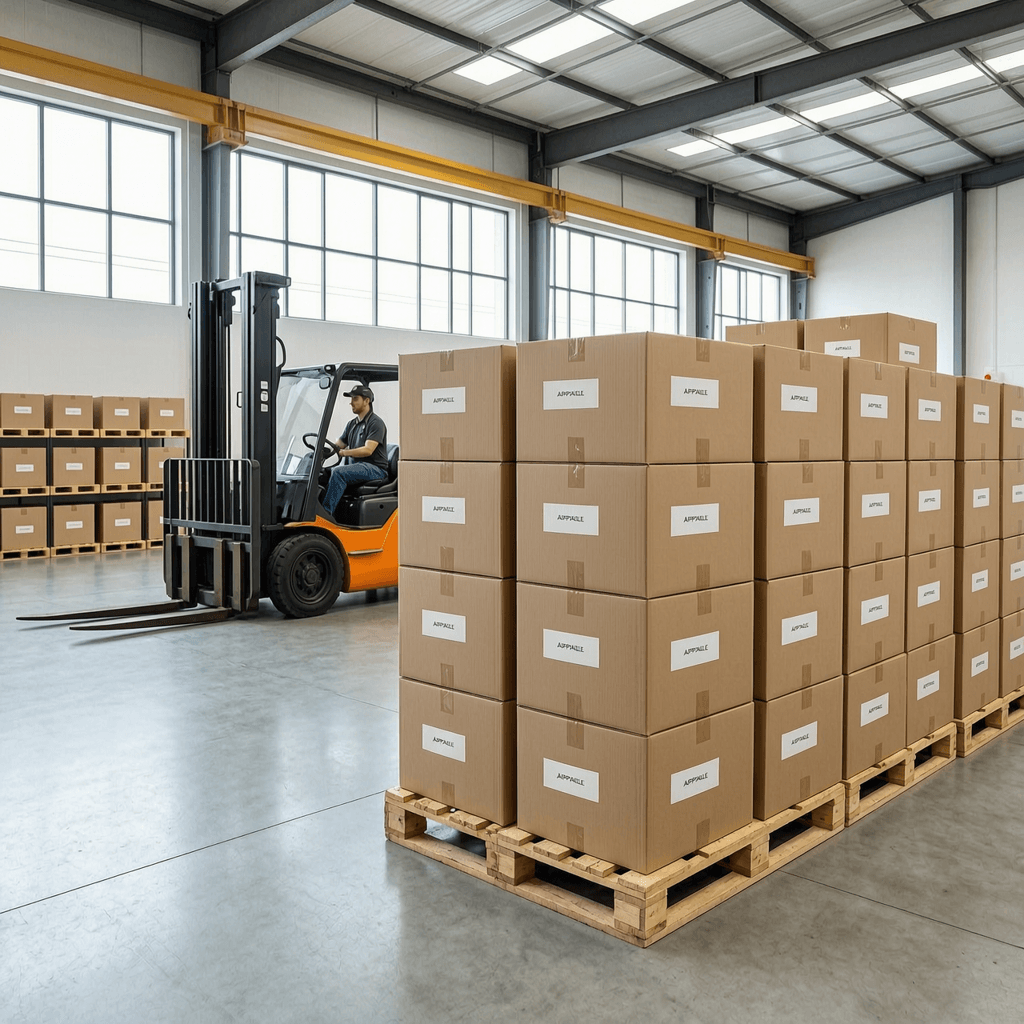
Technical Specifications for Apparel Packaging and Shipping
Standardizing export carton specifications is the first line of defense against damaged cargo and inflated freight rates. Sourcing managers should specify double-wall corrugated cardboard cartons meeting the ASTM D642 standard for compressive resistance, typically rated for 200 lbs per square inch (psi) bursting strength or a 32 Edge Crush Test (ECT) minimum. This ensures cartons can be stacked up to 2.5 meters high inside a standard shipping container without collapsing, protecting delicate knitwear from compression creasing.
Furthermore, understanding the International Air Transport Association (IATA) volumetric ratio is vital. For air freight, the volumetric charging formula is:
\text{Volumetric Weight (kg)} = (\text{Length (cm)} \times \text{Width (cm)} \times \text{Height (cm)}) / (5000)
Read more about How to Manage Multiple Product for additional context.
For ocean freight, the standard metric is the Cubic Meter (CBM). An unoptimized carton that contains 30% empty space directly translates to a 30% penalty on shipping costs. Sourcing teams must enforce strict folding and vacuum-packing tolerances—typically limiting internal carton headspace to less than 5%—to maximize density.
Logistics Analysis: Ocean Freight FCL vs. Air Freight Standard
Sourcing decisions often hinge on the financial and temporal trade-offs between maritime and aerial transport. While air transport offers unmatched velocity for seasonal launches, ocean freight remains the backbone of cost-efficient apparel production. Below is a detailed technical comparison of Ocean Freight FCL (using a standard 40-foot High Cube container) and Air Freight Standard, outlining the operational thresholds that dictate selection.
| Logistics Metric | Ocean Freight FCL (40ft HC) | Air Freight Standard |
|---|---|---|
| Average Transit Time | 25 to 40 days | 5 to 10 days |
| Cost per Kilogram Equivalent | 0.40 to 0.80 USD | 4.50 to 8.00 USD |
| Chargeable Weight Threshold | Minimum 15,000 kg (or 15 CBM) | Minimum 45 kg |
| Volumetric Conversion Factor | 1 CBM = 1,000 kg | 1 CBM = 167 kg |
| Carbon Emissions (CO₂e/ton-km) | 10 to 40 grams | 500 to 800 grams |
| Package Damage/Loss Rate | 1.2% to 2.5% of shipments | 0.15% to 0.30% of shipments |
| Customs Clearance Duration | 48 to 72 hours | 12 to 24 hours |
| Minimum Volume for Cost Parity | \ge 15 CBM | < 1.5 CBM |
This comparison demonstrates that ocean freight is the mathematically superior choice for steady-state inventory replenishment, offering an average a meaningful reduction in per-kilogram transport costs compared to air freight. However, to capture these savings, procurement managers must plan for a 25-to-40-day transit buffer and ensure their production volumes consistently meet the 15 CBM threshold where FCL becomes financially viable.

Packaging Optimization for Knitwear and Woven Products
For midweight knitwear, such as a 7GG to 10GG Merino wool sweater (using fine \le20µm fibers), the structural loft of the yarn poses a unique shipping challenge. Chunky 3GG to 5GG knitwear contains significant trapped air, meaning that uncompressed packaging can cause shippers to pay for “empty space.” Suppliers like Cogarm address this by engineering custom folding guides that minimize the height of individual polybags, allowing a standard export carton to hold 40 units instead of 25. For finer 12GG to 18GG superfine Merino (\le18.5µm) or Grade A Cashmere (\le15.5µm) sweaters, vacuum sealing is balanced carefully against fiber compression limits to prevent permanent creasing of the delicate raw yarns.
— as detailed in our article on How to Manage Multiple Product Lines Simultaneously.
Woven garments present a different logistics footprint. A clothing factory producing structured woven coats or trousers operates under different bulk volume-to-weight ratios than a knitwear mill. For these items, flat-pack carton dimensions must be matched precisely to the garment’s shoulder or waist measurements to prevent shifting during transit, which can cause wrinkling and require expensive post-receipt pressing. By standardizing carton sizes to perfectly match the nested layout of 200 woven units (the standard woven MOQ), importers eliminate the need for void-fill materials, reducing carton weight and saving up to 1.20 per unit in volumetric air freight surcharges.

Strategic Sourcing and Regional Consolidation
Optimizing the logistics of custom apparel requires a manufacturing partner with a highly sophisticated regional infrastructure. Sourcing from a supplier like Cogarm, which leverages a dual-base manufacturing strategy in Dongguan, offers significant transit advantages. By positioning cut-and-sew production in Humen and premium knitwear manufacturing in Dalang, the entire textile manufacturing supply chain is consolidated within a 30-mile radius of major southern Chinese shipping ports. This proximity reduces inland drayage costs and allows for seamless consolidation of mixed knit and woven shipments into a single FCL container.
This logistical efficiency is paired with flexible operational parameters, including an MOQ of 100 pieces per color/style for knitwear and 200 pieces for woven garments. With a standard sample lead time of 15 to 20 days (plus an additional 5 to 7 days for sourced yarns), brands can quickly execute physical prototypes and verify packaging dimensions before mass production begins. Crucially, global compliance standards such as OEKO-TEX, GOTS, GRS, and BSCI are integrated directly into the production process when required by client specs, ensuring that bulk goods clear customs smoothly without costly administrative delays or regulatory holds. Sourcing teams can secure exact color fidelity through Pantone TCX matching, eliminating the risk of costly returns due to color deviations.
Freight Mode Selection by Order Profile
Specify Ocean FCL container shipping for standardized, high-volume apparel production runs exceeding 5,000 units where lead times permit a 45-to-60-day window from sample approval. Specify Air Freight Standard or express courier for low-MOQ test runs under 500 units, high-value Cashmere lines, or immediate seasonal inventory replenishments requiring delivery under 10 days.
For a deeper dive, see What Information to Provide in an RFQ.
Frequently Asked Questions
How does yarn gauge affect bulk shipping density and carton volume?
Heavy 3GG-5GG chunky knits require roughly 40% more box volume than 12GG-18GG fine sweaters, requiring vacuum packaging or larger carton dimensions to avoid volumetric surcharges.
What is the impact of AQL 2.5 inspection on shipping timelines?
Performing an AQL 2.5 inspection at the factory floor takes 1 to 2 days but prevents defective bulk batches from being shipped, eliminating the extreme cost of return logistics.
How does dual-base manufacturing in Humen and Dalang reduce inland freight costs?
It consolidates woven and knitwear production within a single geographic hub, allowing buyers to combine distinct product lines into one FCL shipment at Shenzhen ports.
What is the standard production lead time for a bulk knitwear order?
The standard timeline is 45 to 60 days from sample approval, which requires procurement managers to book ocean freight space at least 3 weeks in advance.
Protecting Margins Through Engineered Logistics
Navigating the complexities of bulk garment logistics requires a meticulous approach to both packaging engineering and freight selection. By standardizing export carton dimensions, optimizing folding configurations, and aligning transport modes with order volumes, procurement teams can protect their bottom line.
To see how optimized packaging can reduce your shipping overhead, request a custom knitwear or woven garment spec sheet with full packaging density calculations and compliant material samples from Cogarm.
