

Exporting apparel to highly regulated markets like the European Union and North America requires strict adherence to international safety and sustainability standards. Sourcing teams must navigate complex chemical restriction frameworks, social compliance criteria, and material traceability requirements to protect their brands from costly customs seizures and reputational damage. This guide provides a detailed technical comparison of the leading textile compliance frameworks to help procurement managers establish risk-free apparel production chains.
Global retail leaders have instituted aggressive sustainability mandates, setting a precedent that has transformed the broader apparel sector. Sourcing managers can no longer rely on unverified supplier claims; every batch of imported yarn, dye, and finished garment must be backed by concrete chain-of-custody documentation.
When importing apparel into the United States or the EU, compliance is a legal baseline rather than a marketing differentiator. Shipments failing to meet chemical limits or containing uncertified recycled claims face immediate detention at the port of entry. For example, failing a random REACH phthalate screening can lead to the destruction of an entire season’s inventory, completely wiping out a retailer’s projected margin.
(See our related guide: Understanding Global Environmental Certifications.)
To mitigate these supply chain risks, procurement professionals must implement rigorous quality assurance protocols and select certified raw materials. Understanding the technical boundaries between key environmental and chemical safety standards is the first step toward building a compliant, high-performance sourcing strategy.

Navigating the Textile Regulatory Landscape
Legally binding regional regulations dictate the baseline safety requirements for textile imports. In the European Union, the REACH regulation (EC 1907/2006) limits Substances of Very High Concern (SVHCs)—including lead, cadmium, and specific phthalates—to a strict threshold of ≤0.1% by weight. In the United States, the Consumer Product Safety Improvement Act (CPSIA) enforces a limit of 100 ppm for total lead content in accessible substrates of children’s products, alongside a 1,000 ppm limit for specified phthalates.
To satisfy these statutory requirements, the global textile industry relies on voluntary certification systems that act as proxies for compliance. Standards such as OEKO-TEX Standard 100 test finished garments for over 300 harmful chemical substances, ensuring compliance with both REACH and CPSIA. For brands making environmental claims, environmental traceability frameworks like the Global Organic Textile Standard (GOTS) and the Global Recycled Standard (GRS) ensure that raw material inputs are fully traceable from source to final product.
GOTS vs. GRS: A Technical Comparison
When choosing certified materials for garment manufacturing, procurement teams must distinguish between organic origin standards and recycled content standards. Both frameworks require strict transaction certificate (TC) tracking at every stage of processing, but they enforce different chemical and physical thresholds.
Read more about Why Premium Merino Wool is Ess for additional context.
| Technical Metric | Global Organic Textile Standard (GOTS v7.0) | Global Recycled Standard (GRS v4.0) |
|---|---|---|
| Minimum Certified Input | 70% organic fiber (for “Made with Organic” label) | 20% recycled fiber for tracking; 50% for product labeling |
| Allowed Blending Limit | Max 30% non-organic fibers; max 10% synthetic/regenerated | Up to 80% non-recycled fiber blends for certified batches |
| Total Lead (Pb) Limit | < 1.0 mg/kg (detection limit) | < 50.0 mg/kg (general substrate limit) |
| Formaldehyde Limit | ≤ 16.0 mg/kg for baby products; ≤ 150.0 mg/kg for adult | ≤ 16.0 mg/kg for baby products; ≤ 75.0 mg/kg for adult |
| Wastewater COD Discharge | < 20.0 g/kg of organic output (treated onsite/offsite) | < 150.0 mg/L treated effluent discharge (per ZDHC guidelines) |
| pH Value Acceptable Range | 4.0 to 7.5 | 4.0 to 9.0 |
| Social Audit Frequency | Mandatory annual audit (12-month cycle) | Mandatory annual audit (12-month cycle) |
| Traceability Mechanism | Transaction Certificates (TCs) per shipment | Transaction Certificates (TCs) per shipment |
This comparison highlights that while GOTS enforces tighter limits on raw material purity and chemical inputs, GRS permits broader material blending while maintaining rigorous social and wastewater management criteria. Importers must balance these limits against their product performance requirements.

Material Specifications and Use Cases
Selecting the correct fiber specification is critical to ensuring both regulatory compliance and the desired tactile handfeel of the garment. For premium knitwear, specifying the precise micron (µm) range of animal fibers directly impacts the finished product’s quality and compliance pathway:
- Superfine Merino Wool (≤18.5µm): Ideal for lightweight, close-to-skin activewear.
- Fine Merino Wool (≤20µm) & Medium Merino Wool (≤22µm): Excellent for midweight 7-10GG (gauge) knitwear.
- Grade A Cashmere (≤15.5µm): Reserved for luxury knitwear, providing maximum thermal insulation at minimum weight.
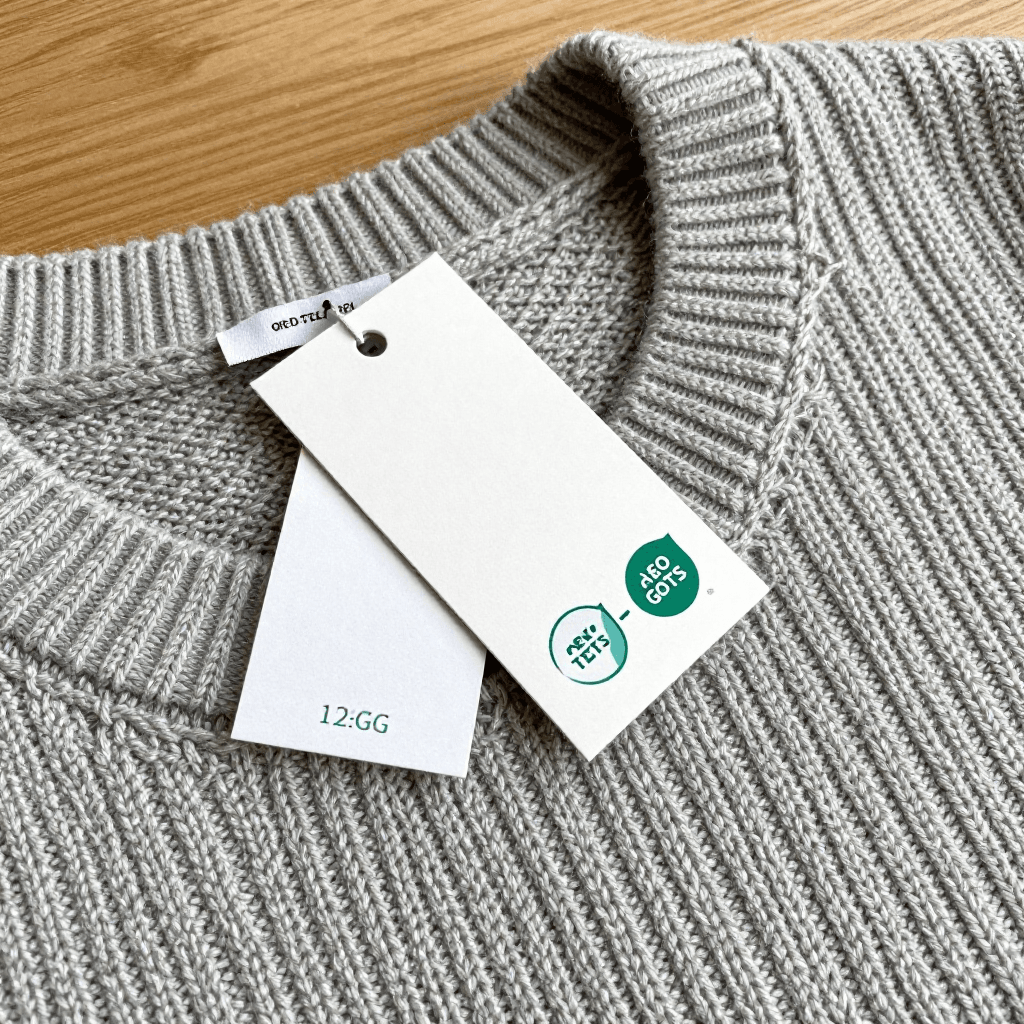
For midweight 7-10GG knit sweaters and fine 12-18GG sweaters, material choices often involve fiber blends. Blending organic cotton or Merino wool with technical synthetics like acrylic or viscose (such as LENZING ECOVERO) improves durability and shape retention.
To satisfy international import laws, any blended yarn—whether cotton, wool-acrylic, or recycled wool (GRS)—must undergo AQL 2.5 inspection to verify structural integrity and dimensional stability. Additionally, using Pantone TCX matching ensures dye-lot precision across batches without relying on heavy-metal dyestuffs, maintaining compliance with chemical safety limits.
— as detailed in our article on Why “Slow Fashion” Brands are Choosing OEM.
Navigating Sourcing and Production Timelines
Achieving global regulatory compliance requires structured manufacturing timelines. Suppliers like Cogarm leverage a specialized footprint, with their Humen base dedicated to cut-and-sew woven garments and their Dalang base focusing on premium knitwear. This dual-base manufacturing structure allows Cogarm to maintain strict oversight of compliance standards, integrating OEKO-TEX, GOTS, GRS, and BSCI parameters when required by client specifications.
[Design & Tech Pack] ➔ [Yarn Sourcing (5-7 Days)] ➔ [Sample Lead (15-20 Days)] ➔ [Sample Approval] ➔ [Bulk Production (45-60 Days)] ➔ [AQL 2.5 Inspection & Shipping]
To optimize the compliance pipeline, procurement managers should plan for a sample lead time of 15-20 days, plus an additional 5-7 days for sourcing specialized certified yarns. Once sample approval is granted, bulk production requires 45-60 days to allow for proper dyeing, knitting, and finishing under strict AQL 2.5 quality control standards. The typical commercial payment structure is structured as a 30% deposit with the remaining 70% settled before shipment.
Compliance Specification by Market
Specify GOTS organic cotton and superfine ≤18.5µm Merino wool for close-to-skin baby apparel and premium activewear requiring zero toxic chemical residues. Specify GRS recycled wool and wool-acrylic blends for heavy 3-5GG chunky outerwear where circularity and high durability are the primary export compliance objectives.
FAQ
What are the primary lead times for a certified custom sweater production run?
Sample development takes 15-20 days, plus an additional 5-7 days if sourcing specialized certified yarn, followed by bulk production of 45-60 days from sample approval.
For a deeper dive, see Our Approach to Collaborative Product Development.
What is the typical inspection tolerance standard for export garment manufacturing?
Quality control generally operates under the AQL 2.5 inspection standard for major defects to satisfy both US and EU customs quality expectations.
How are GOTS and GRS transactions verified during importing?
Importers must receive a Transaction Certificate (TC) issued by an authorized certification body for every single shipment of certified goods to verify the organic or recycled claim.
What is the minimum order quantity (MOQ) for custom compliant knitwear and woven items?
The standard MOQ is 100 pieces per color and style for premium knitwear, and 200 pieces for custom woven garments.
Streamlining Your Compliance Strategy
Establishing a legally compliant apparel supply chain requires balancing raw material chemistry with traceable certification systems. By aligning product specifications with voluntary standards like OEKO-TEX, GOTS, and GRS, importers can mitigate customs risks and meet consumer demand for sustainable products. Partnering with dual-base manufacturers that offer low minimum order quantities (100 pcs for knitwear/200 for woven) helps brands test compliant product lines with minimal upfront inventory risk.
Request a compliant material sample with full Transaction Certificate (TC) and OEKO-TEX test reports from Cogarm to verify fiber purity and regulatory safety.
