

Evaluating modern apparel production capabilities requires looking deep into the knitting machinery and factory automation systems that drive output consistency and scale. Investing in advanced computerized flat knitting machinery in Dongguan allows textile producers to eliminate the structural defects common in legacy manual production while hitting tight tolerances. This analysis provides procurement managers and supply chain directors with the technical data required to assess capital investment advantages and select the optimal knitting technology for high-end knitwear lines.
Just as precision manufacturers rely on automated CNC milling to achieve the precise tolerances of its aluminum unibody designs, global fashion brands now depend on digital garment manufacturing to scale complex knit patterns without sacrificing fabric integrity. The transition from legacy manual flat knitting to fully computerized, multi-gauge knitting machinery has transformed apparel production from an artisanal craft into a highly predictable engineering process.
High-end consumer brands require absolute repeatability across thousands of units. When sourcing custom sweaters made of superfine merino wool, cashmere, or technical cotton blends, even a minor variance in stitch tension or yarn feed rate can lead to distortion after the first wash, directly impacting a retailer’s return rate and brand equity.
(See our related guide: Our Commitment to Local Community and Industry.)
This article explores how modern computerized flat knitting machinery—specifically comparing multi-gauge computerized machines against conventional manual or semi-automatic systems—impacts yarn utilization, structural consistency, and lead times. By understanding these technical variables, procurement professionals can mitigate supply chain risks, optimize their landed costs, and make highly informed sourcing decisions.
Technical Specifications and Raw Material Tolerances
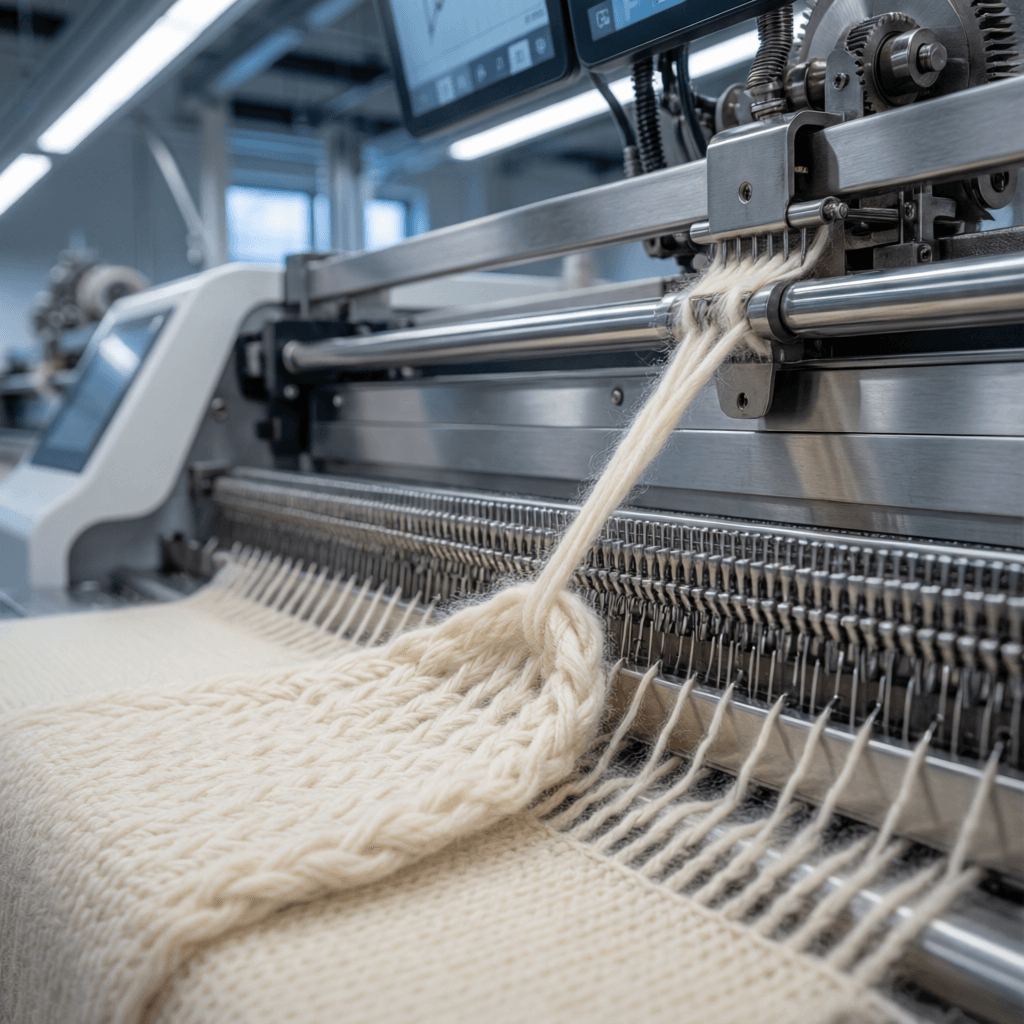
Technical parameters dictate the performance of apparel production lines. In premium knitwear, thickness and density are controlled via machine gauge (GG), representing the number of needles per inch. Modern textile manufacturing relies on a broad gauge range from 3GG to 18GG, where 3-5GG produces heavy, chunky knits, 7-10GG delivers midweight structures, and 12-18GG yields fine, lightweight fabrics.
Precision in raw material selection is equally critical. For premium product lines, specifications must define fiber diameter: Merino wool ranges from 17-24µm (with superfine classified as ≤18.5µm, fine as ≤20µm, and medium as ≤22µm), while Grade A Cashmere must measure ≤15.5µm. Keeping raw materials within these strict micron tolerances prevents the prickle effect and optimizes tactile hand feel.
Quality assurance metrics must align with international standards. To ensure batch-to-batch consistency across complex fiber blends, production audits utilize the AQL 2.5 inspection standard for both knit and woven garments. Furthermore, color accuracy is maintained via electronic spectrophotometers calibrated to Pantone TCX matching standards, guaranteeing that dyed yarns remain within a Delta E (dE) color variance of ≤1.0.
Read more about Why Premium Merino Wool is Ess for additional context.
Machine Performance Comparison: Computerized vs. Manual Flat Knitting
When evaluating garment manufacturing partners, understanding the machine-level performance differences is key. Traditional manual or semi-automatic flat knitting machines rely heavily on operator skill, which introduces high variance in stitch tension, established to inconsistent dimensions and high fabric waste. Conversely, computerized flat knitting systems use precision servomotors and digital controls to stabilize the fabrication process.
Below is a technical comparison of the performance specifications between computerized flat knitting machinery (such as Shima Seiki or Stoll) and conventional manual/semi-automatic systems.
| Performance Metric | Computerized Flat Knitting (e.g., Shima Seiki / Stoll) | Conventional Manual/Semi-Automatic Flat Knitting |
|---|---|---|
| Dimensional Tolerance (Stitch Length) | ±1.0% deviation across 1,000 units | ±5.0% deviation across 1,000 units |
| Needle Selection Control | Electronic individual needle actuators | Mechanical jacquard jacks or manual sliders |
| Yarn Tension Regulation | Closed-loop digital tensioners (0.1g resolution) | Mechanical spring tensioners (no active feedback) |
| Pattern Setup Time (Changeover) | 15–30 minutes (via digital file load) | 4–8 hours (manual needle and cam adjustment) |
| Intarsia / Jacquard Color Capacity | Up to 32 yarn carriers | Maximum 4–6 colors (highly labor-dependent) |
| Defect Rate per 1,000 Units | ≤3 units (0.3% automatic stop on yarn break) | 25–40 units (2.5%–4.0% operator error rate) |
| Gauge Flexibility | Multi-gauge capability (3GG to 18GG on one bed) | Fixed single gauge per machine bed |
| Material Waste (Knit-to-Shape) | 1% to 3% waste (fully fashioned panels) | 15% to 22% cutting waste from flat panels |
The key takeaway from this comparison is the dramatic reduction in fabric waste and defect rates. By utilizing digital yarn tensioners and individual needle actuators, computerized machines maintain tension tolerances within 0.1g, preventing the puckering or loose stitches that ruin fine-gauge luxury knitwear. Additionally, the transition to fully fashioned (knit-to-shape) production reduces material waste to under 3%, compared to up to 22% waste in traditional cut-and-sew lines. However, manual knitting remains a viable, lower-capital alternative for highly localized, short-run 3GG chunky knits where structural complexity is low.
Custom Apparel Applications and Performance Profiles
Different fabric weights and yarn compositions demand tailored machinery configurations to perform reliably under consumer use. Modern clothing factories segment their equipment to match these specific material profiles.
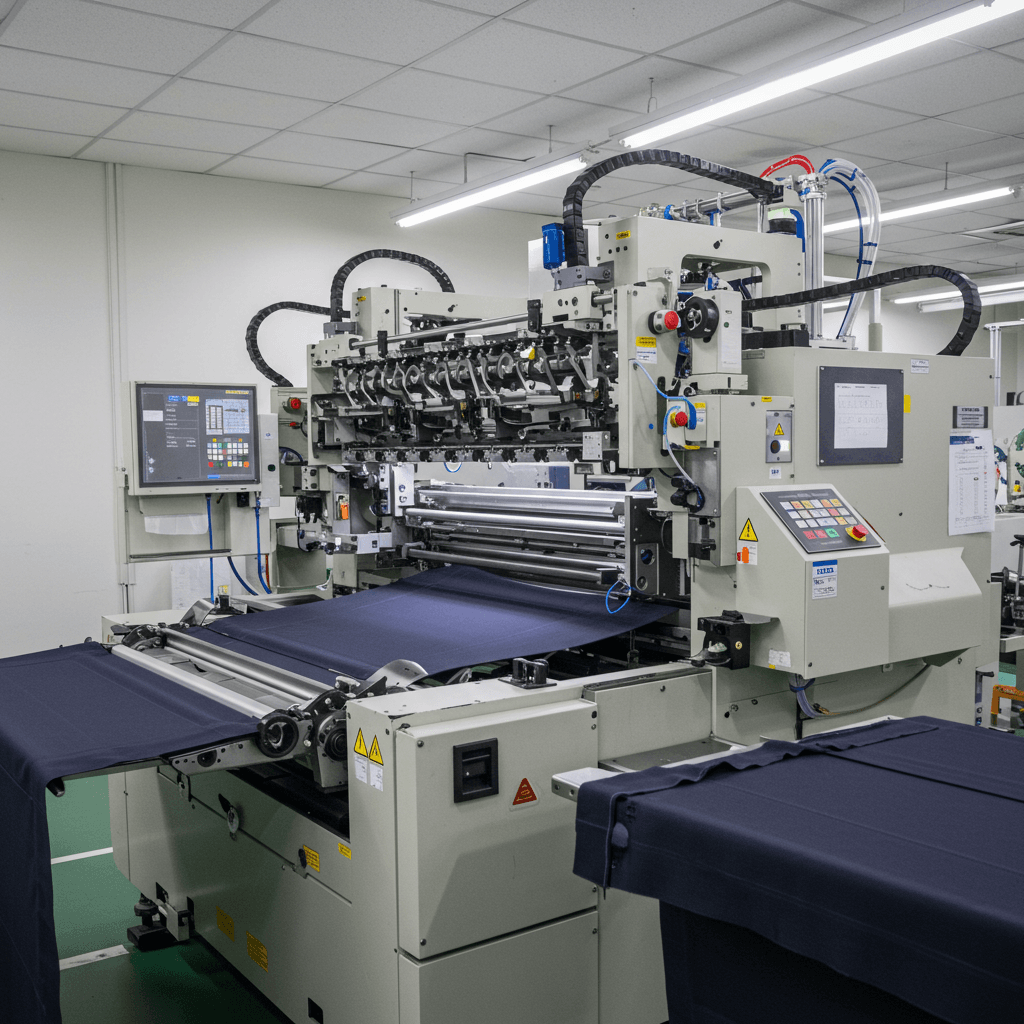
To achieve these rigorous standards, established garment manufacturing facilities utilize advanced computerized flat knitting hubs. For instance, suppliers like Cogarm operate dual-base manufacturing setups—with Humen dedicated to high-efficiency cut-and-sew woven garments and Dalang specialized in premium knitwear—to optimize production speed.
For high-end corporate or retail brands requiring lightweight performance, a 12GG or 14GG custom sweater utilizing a blend of superfine merino wool (≤18.5µm) and combed cotton provides excellent breathability and thermal regulation. Computerized flat knitting enables seamless integration of these delicate fibers without causing thread breakages, maintaining a structural stability that withstands industrial laundering.
— as detailed in our article on How We Solved Complex Pattern Matching Issues.
Conversely, for outdoor apparel brands designing rugged, heavy-knit cardigans, a 3GG or 5GG chunky knit construction using a durable wool-acrylic or lambswool blend is ideal. By using digital machinery, these thick yarns can be structured into intricate cables and ribbing with a consistent density that keeps its shape over years of use, avoiding the common issue of sagging or stretching under its own weight.
Material Performance Across Sourcing Markets
Different fiber selections require dedicated machinery settings. For example, Cashmere Grade A (≤15.5µm) has a short staple length compared to merino wool or cotton, making it highly susceptible to yarn breakage under uneven tension. Computerized tension controls dynamically adjust feed rates to compensate for fiber elasticity variations, ensuring smooth, defect-free apparel production. This is crucial for brands scaling from initial collections to high-volume distribution in EU and North American markets.
Sourcing Architecture and Manufacturing Solutions
When navigating complex apparel production schedules, working with an agile partner is essential. Companies like Cogarm streamline this transition by providing flexible minimum order quantities (MOQs) starting at 100 pcs per colour/style for knitwear, and 200 pcs for woven garments, allowing brands to test market demand with minimal inventory exposure.
To accelerate time-to-market, partners such as Cogarm deliver initial prototypes within a sample lead time of 15-20 days (plus 5-7 days if sourcing specialized custom yarns). This engineering-first approach ensures that global compliance standards—such as OEKO-TEX, GOTS (for organic cotton), GRS (for recycled wool), and BSCI—are fully integrated into the manufacturing process according to client specifications, providing complete transparency and a verified chain of custody.
The operational flow concludes with balanced commercial terms. Production runs are executed within 45-60 days from final sample approval, backed by a standard payment structure of 30% deposit and 70% before shipment, ensuring clear financial milestones for both parties.
When to Specify Computerized Knitting
Specify computerized flat knitting (3GG-18GG) for high-performance, complex knitwear designs, fine-gauge merino/cashmere blends, and fully fashioned, low-waste garment manufacturing. Specify manual or semi-automatic flat knitting for basic, low-complexity chunky knits where labor cost-efficiency is prioritized over micro-dimensional tolerances and tight quality control.
For a deeper dive, see.
FAQ
Frequently Asked Questions
What is the benefit of a multi-gauge knitting machine over a single-gauge machine?
Multi-gauge computerized machines allow designers to combine different knit structures (like 7GG and 12GG) in a single panel without physical needle changes, reducing pattern setup times to under 30 minutes.
How does raw fiber micron size affect knitwear durability?
Finer fibers, such as Grade A cashmere (≤15.5µm) or superfine merino wool (≤18.5µm), feel softer but require precise digital tension controls (within 0.1g) during knitting to prevent thread breakages and subsequent pilling.
What are the standard lead times for custom knitwear development?
The typical development cycle consists of 15-20 days for sample production (plus 5-7 days for sourcing custom dyed yarns), followed by 45-60 days for mass apparel production post-sample approval.
How is color accuracy managed across different batches in garment manufacturing?
Color consistency is maintained by executing dyed yarn matching against the Pantone TCX color system, verified by digital spectrophotometers to meet a Delta E tolerance of ≤1.0.
Engineering Consistency in Fashion Supply Chains
Selecting the right knitting machinery is the foundation of structural durability and batch consistency in apparel production. For modern sourcing managers, transitioning from manual processes to computerized flat knitting is not merely a matter of speed; it is an essential step to lock in structural tolerances, minimize fabric waste to under 3%, and protect the retail brand’s quality reputation.
Request a custom yarn-dyed sample with full color-matching data and spec sheet from the supplier to evaluate our 12GG and 14GG computerized knitting capabilities for your next premium apparel collection.
