
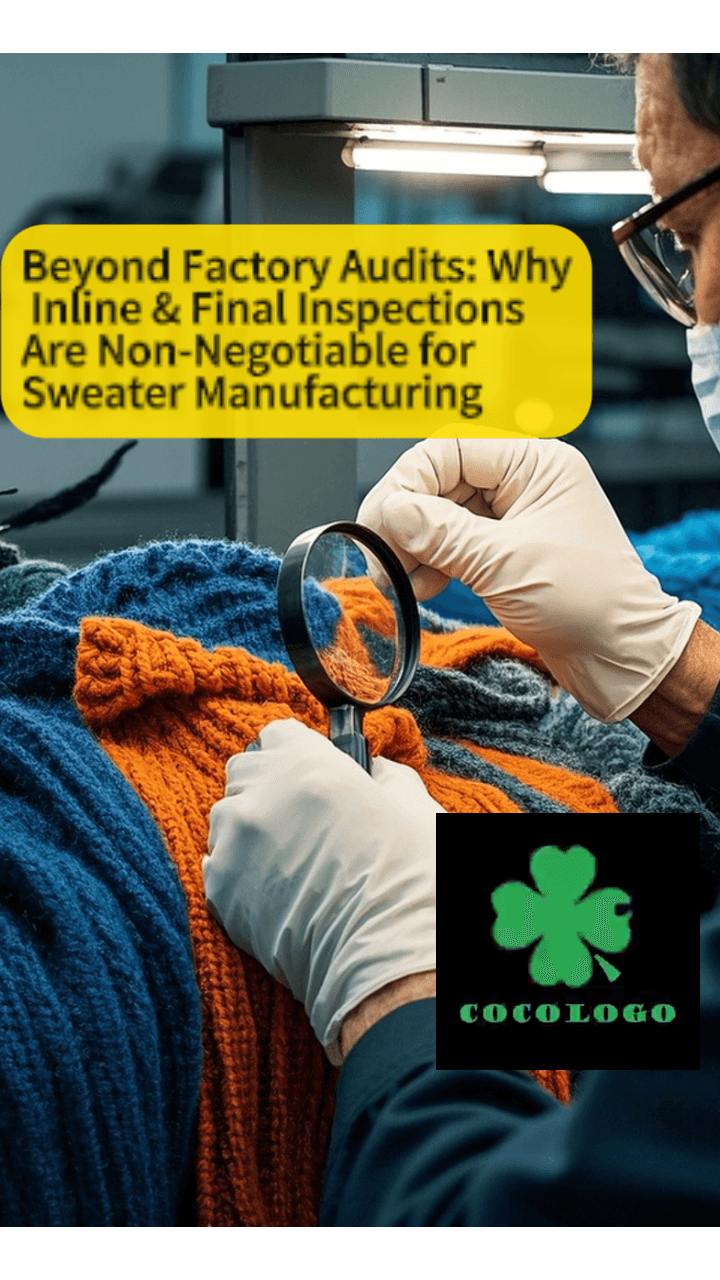
While a factory audit (e.g., assessing facilities, certifications, and capacity) forms the foundation of supplier evaluation , it alone cannot guarantee product quality. For sweater production—where complexities like yarn consistency, knitting precision, and finishing details matter—real-time inline inspections and rigorous final inspections are critical safeguards. Here’s why:
1. The Limits of Factory Audits
Audits verify potential, not performance. For example:
- Certifications (ISO, BSCI, etc.) indicate compliance but not day-to-day execution .
- Equipment lists (e.g., computerized knitting machines) don’t ensure proper operation or maintenance.
- Capacity claims may overlook quality compromises during peak loads .
Audits are a snapshot; inspections monitor continuity.
2. Inline Inspection: Catching Defects Early
Sweater production involves multi-stage processes (yarn dyeing → knitting → stitching → finishing). Inline checks at each phase prevent minor errors from compounding:
- Yarn & Knitting Stage: Verify gauge consistency, stitch density, and pattern alignment using industry terms like nominal yarn count and herringbone structure .
- Assembly Phase: Check seam strength, collar symmetry, and sleeve attachment.
- Dyeing/Washing: Monitor colorfastness and shrinkage rates.
⚠️ Example: A factory audit might confirm the presence of 14G knitting machines, but only inline checks can detect uneven tension causing fabric pilling.
3. Final Inspection: The Last Line of Defense
Pre-shipment inspections validate bulk quality against 4 key criteria:
- Workmanship: Stitching defects (e.g., dropped stitches), loose threads, or misaligned patterns.
- Measurements: Size tolerances (e.g., chest width, sleeve length) per tech specs.
- Safety & Compliance: Metal detection (for needles), chemical testing (azo dyes), and security protocols (e.g., GSV for Walmart suppliers) .
- Packaging/Labeling: Accurate SKUs, polybag seals, and hangtag placement.
�� Data-Driven Approach: Use AQL (Acceptable Quality Level) sampling to statistically reject defective batches. For instance, 2.5% defects in a 500-unit order may trigger rejection.
4. Real-World Impact: Case Study
A brand skipped inline checks for a “cost-efficient” Chinese sweater factory (audit-passed with ISO 9001 .
- Final discovery: 15% rejection rate at port, causing $50K losses.
Conclusion: Audit + Inspection = Reliable Partnership
Factory audits assess capability; inspections ensure accountability. For sweaters—where handcrafted elements (e.g.,seaming process , sweater production terminologies , and compliance protocols .