

GOTS and GRS answer different questions: GOTS verifies that a garment’s natural fiber was grown organically and processed without hazardous chemistry, while GRS verifies that recycled content — at least 20% by weight, 50% to carry the consumer logo — has been traced from collection point to finished product. Pick the certification that matches your fiber strategy, then qualify your supplier’s chain-of-custody paperwork before you cut a single sample. This guide walks through the fiber standards, the structural comparison, the gauge and blend engineering behind compliant knitwear, and the verification steps every procurement team should run before committing a program.
Why Certification Now Decides Garment Sourcing Outcomes

Ten years ago, a sustainability claim on a hangtag was marketing. Today it is a specification, and increasingly a legal one. Greenwashing rules in the EU and the US mean a brand that prints “organic” or “recycled” on a label without documentation can face customs holds, delistings, or outright recalls. Large retailers have set carbon and material targets that flow straight down to procurement — which means the sourcing manager, not the marketing department, now owns the certification file.
The practical consequence is simple. When you scope a custom knitwear program, the certification question belongs in the tech pack next to the gauge and the yarn count, not in an appendix. We see this at trade fairs constantly: the first questions buyers ask us are no longer only about price and lead time, but about which scope certificates we hold and whether a transaction certificate can be issued for their specific lot. The industry has moved from transactional purchasing to documented partnerships, and the two documents at the center of that move are GOTS and GRS.
What Raw Material Standards Should You Demand Before Signing?
Start with the fiber itself, because no certification rescues a bad input. For natural fibers, the core requirement is agricultural purity — no hazardous pesticide residues, and full traceability back to the farm. Organic cotton must meet the agricultural mandates of the Global Organic Textile Standard (see global-standard.org) from the seed stage onward.
For animal fibers, the measurable criterion is fiber diameter, and here the numbers matter more than the adjectives. Superfine Merino must measure 18.5 microns or finer; fine Merino sits at 18.6–20.5 microns; medium Merino at 20.6–22.5 microns. Cashmere Grade A — the only grade we use for next-to-skin luxury programs — requires a threshold of 15.5 microns or below. If a supplier quotes you “cashmere” without a micron figure, ask again. On our floor, every incoming lot of wool or cashmere is checked against the specified micron count before it enters the spinning queue, because a gauge that is off by two microns shows up later as pilling, not as a lab failure.
For synthetic and blended yarns, the question shifts from agriculture to feedstock origin. Recycled wool, recycled polyester, viscose, modal and LENZING ECOVERO fibers all require dedicated chain-of-custody transaction certificates that document the origin of the post-industrial or post-consumer waste and trace the certified content through spinning to your specific lot. Note what these certificates do and do not prove: GRS permits blending certified recycled fiber with virgin material within declared limits, so a transaction certificate verifies the documented recycled-content share and its traceability — it is not a guarantee that no virgin fiber entered the yarn. Textile Exchange maintains the GRS framework (see textileexchange.org); the certificate travels with the goods lot by lot, and a buyer is entitled to see it.
How Do GOTS and GRS Compare Structurally?
The honest answer: both standards enforce real chemistry and real audits, but they police different supply chains. GOTS governs organic natural fiber from farm to finished garment, with a minimum certified input of 70% organic fiber (95% for the “organic” grade label). GRS governs recycled content from the collection point onward, with a 20% minimum for certification and 50% for the consumer-facing logo. Below is the comparison as procurement teams should read it.
| Parameter | GOTS Specification | GRS Specification |
|---|---|---|
| Minimum certified input | ≥70% organic fiber (95% for “Organic” grade) | ≥20% recycled content (≥50% for logo use) |
| Formaldehyde limit (baby / adult) | ≤16 ppm / ≤75 ppm (GOTS RSL) | Not separately set by GRS; ZDHC MRSL governs input chemistry |
| Wastewater load | <20 g/kg COD per kg of organic textile output | Deferred to ZDHC wastewater guidelines or local discharge law |
| pH tolerance (ISO 3071) | 4.0–7.5 (GOTS RSL) | Not set by GRS; ZDHC MRSL governs chemistry |
| Extractable lead in inputs | ≤50.0 mg/kg (GOTS RSL) | Not separately specified; GRS relies on ZDHC MRSL |
| Audit cycle | 12 months, with annual physical inspection | 12 months, with annual physical inspection |
| Chain of custody | From seed source to garment manufacturing | From recycling collection point to finished garment |
| Blend tolerance | ≤25% non-organic fibre permitted (≤10% for certain items such as socks and underwear) | Up to 80% virgin synthetics or naturals permitted |
Read the table as a decision rule rather than a scorecard. If your program is built on natural, next-to-skin fiber — pure organic cotton, cotton-modal, quality wool — GOTS is the correct instrument because it audits wet processing and social criteria alongside fiber origin. If your program is built on diverted waste — recycled polyester fleece, GRS recycled wool blends — GRS is the correct instrument, and its chemical requirements are checked through the ZDHC MRSL rather than a separate GRS product-limit list. Both run on 12-month audit cycles, so a supplier’s certificate you are shown today can lapse next quarter; check validity dates, not just logos. Skin-compatibility limits such as the 4.0–7.5 pH band per ISO 3071 and the OEKO-TEX chemical framework (see oeko-tex.com) apply across both routes, which is why we hold OEKO-TEX Standard 100 alongside GOTS and GRS scope at Cogarm.
Which Gauge and Blend Serve Which Compliant Program?
Certification gets you through customs; engineering gets you through the season. The knit gauge determines how much stress the yarn must survive, and that in turn narrows which certified yarns are practical.
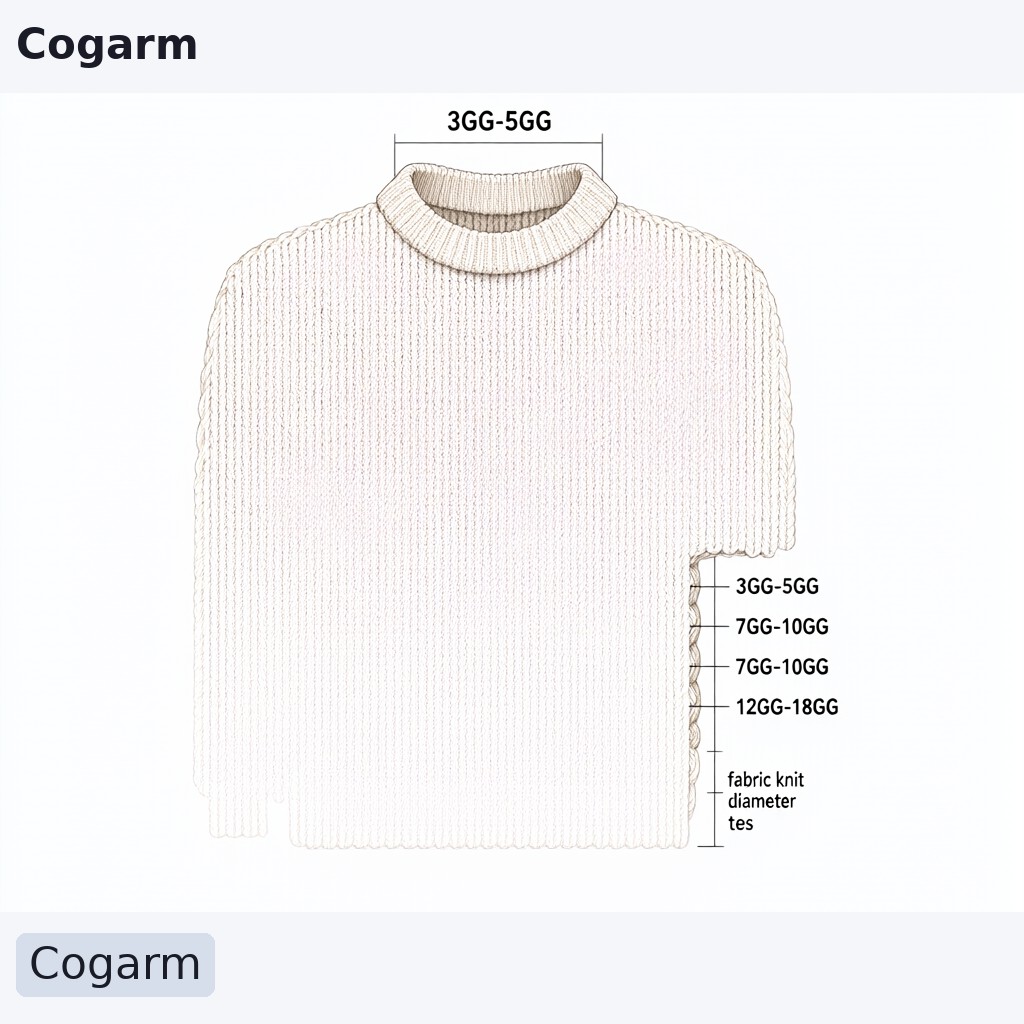
Chunky knits on 3GG–5GG machines put heavy loops and heavy loads on the yarn, so they demand stable, low-pilling fiber — this is where GRS recycled wool earns its keep, provided the recycled fiber is blended and spun for structure rather than softness alone. Midweight garments on 7GG–10GG and fine-gauge pieces on 12GG–18GG invert the requirement: the limiting factor becomes yarn diameter consistency, because a thick slub binds the needle at speed and stops an entire knitting floor.
A worked example. A luxury outerwear brand building a winter capsule would reasonably specify a 12GG fine-gauge knit in superfine Merino (≤18.5µm) blended with Cashmere Grade A (≤15.5µm) under GOTS — soft hand-feel, documented origin. A high-volume corporate uniform program points the other way: a GOTS organic cotton core blended with GRS recycled polyester, knitted on a 14GG machine, delivers the tensile strength and colorfastness a uniform needs at a certificate stack the client’s ESG report can use. There is always a trade-off to state plainly: GRS-heavy blends buy waste-diversion credit but cap the fiber’s hand-feel ceiling, and if touch is the selling point, the organic-natural route still wins despite its higher input cost.
We write this from the factory floor: the yarn that moves last in a quote is always the certified one, because sourcing a certified lot adds 5–7 days of procurement. Build that into your calendar rather than discovering it at the sample stage.
How Do You Verify a Supplier Before You Commit?
Paperwork first, floor second. Ask for the supplier’s scope certificate number and look it up on the certifier’s public database — GOTS and GRS both allow this, and any factory that resists the lookup is telling you something. Then ask for a transaction certificate template for your program: a factory can hold a scope certificate and still fail to link your specific order into the chain of custody.
On the production side, verification means measured QC, not slogans. Anchor bulk inspection to an AQL 2.5 plan per ISO 2859-1 sampling procedures, seal a pre-production sample, and reference color against Pantone TCX with a tolerance of ±1 shade — anything looser invites shade-bar complaints across a knit program where lots arrive weeks apart. Fiber diameter claims should be backed by supplier test data, and shrinkage behavior confirmed against post-wash testing per AATCC 135, where industry-accepted performance sits within a low single-digit percentage band.
The question buyers ask us most is whether low minimums and certification can coexist. They can, with conditions. Cogarm runs knitwear at an MOQ of 100 pieces per style and colour — at the accessible end of the industry’s typical 50–500 piece range — and 200 pieces for woven programs. The trade-off: certified yarn is bought by the kilo, so at 100 pieces you are effectively paying for the dyelot, not the garment. That is the right trade when you are validating a sustainable line before scaling it; at volume, the certificate cost amortizes and the yarn premium drops.
What Does a Realistic Sustainable Program Timeline Look Like?
Sample first, contract second, bulk third. Sampling at Cogarm runs 10–15 days against an industry average of 25–30, with an added 5–7 days when a specialized certified yarn must be sourced from a mill holding the relevant scope. Once the buyer approves the sample and the pre-production file is sealed, bulk production runs 35–45 days from approval, a window consistent with standard garment manufacturing timelines. Payment follows the standard trade structure: 30% deposit to open the order, 70% before shipment.
Pin the certification chain in writing at the deposit stage, not at shipping. Name the standard (GOTS or GRS), the transaction certificate requirement, the AQL level, and the Pantone tolerance in the purchase order. Compliance scopes — OEKO-TEX, GOTS, GRS, BSCI, WRAP — are integrated when the client’s specification calls for them, and the honest limitation is this: no factory can certify a garment the buyer never specified as certified. The tech pack is where sustainable sourcing either becomes enforceable or stays a slide in a deck.
Which Certification Should Your Program Choose?
Choose GOTS when the selling proposition is natural purity — organic cotton basics, merino and cashmere next-to-skin knits, babywear — because it audits agriculture, wet chemistry and social criteria end to end. Choose GRS when the proposition is waste diversion — recycled wool, recycled polyester, blended performance knits — because it certifies content and traceability from the collection point, with chemistry checked through the ZDHC MRSL rather than a separate GRS product-limit list. Run both when your line does both, and let the fiber strategy, not marketing preference, make the call per style.
Frequently Asked Questions
What is the typical lead time for custom sustainable yarn development?
Plan on 10–15 days for samples, plus 5–7 additional days when a certified yarn must be specially sourced from a scoped mill. Bulk follows at 35–45 days from sample approval. Certified yarn sourcing is the one stage buyers consistently underestimate, so calendar it explicitly.
What is the minimum order quantity for certified knitwear?
Cogarm’s knitwear MOQ is 100 pieces per style and colour, against an industry norm of roughly 50–500 pieces. Woven programs start at 200 pieces per style and colour. At 100 pieces you carry the dyelot economics of certified yarn, which is the trade-off for validating a line small.
How are fiber diameters and material tolerances verified during production?
Incoming wool and cashmere lots are checked against the specified micron band before spinning — Cashmere Grade A, for example, must measure 15.5 micrometres or finer. Bulk is inspected to AQL 2.5 per ISO 2859-1, color matched to Pantone TCX within ±1 shade, and shrinkage confirmed by post-wash testing per AATCC 135.
What payment terms govern standard sustainable production runs?
The standard structure is 30% deposit with order confirmation and 70% before shipment. Certification requirements, transaction certificates and AQL levels should be written into the purchase order at the deposit stage so the compliance chain is enforceable before production starts.
Cogarm has manufactured custom knitwear and woven garments in Dongguan, Guangdong, China since 2006. Minimum order is 100 units per style and colourway.
