

The Blueprint of Precision: How Supplier Translates Concepts into Production-Ready Tech Packs
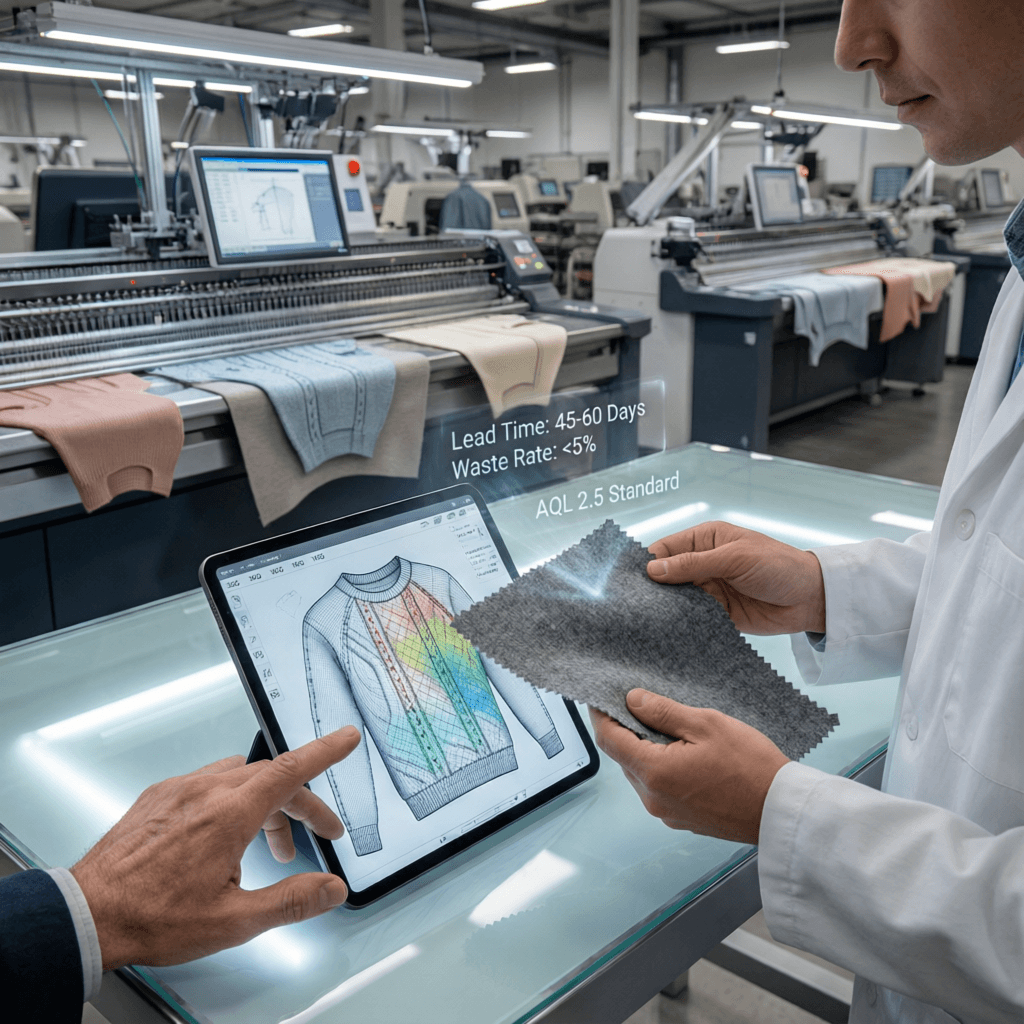
In knitwear OEM, the distance between a designer’s sketch and a finished garment is measured in microns of yarn tension and millimeters of stitch density. At Cogarm, we bridge that gap with a rigorous tech-pack development process that eliminates ambiguity before a single needle moves. A well-constructed tech pack reduces sampling iterations by up to 40% and cuts time-to-production by an average of 18 days per style—critical metrics when your lead times are already compressed.
Our process begins not with a file, but with a structured intake. Every concept—whether a hand-drawn flat sketch, a 3D render, or a reference garment—is parsed into a standardized specification sheet. We assign a unique style code, record the target gauge (from 3-gauge chunky knits to 18-gauge fine gauges), and document the exact yarn count, twist, and fiber blend. For example, a 12-gauge cashmere-silk blend requires a specific needle configuration and tension curve that differs from a 7-gauge cotton-wool mix. These details are non-negotiable from day one.
(See our related guide: Overcoming Technical Failures in Complex Apparel Designs.)
From Sketch to Spec: The Anatomy of a Supplier Tech Pack
A Cogarm tech pack contains 12 mandatory sections, each with quantifiable data points. The core components include:
- Flat Sketch with Measurements: Every panel is dimensioned to ±1 mm tolerance. For a standard crewneck sweater, we specify 18 critical points: chest width (half-measure), body length, sleeve length from center back, shoulder slope, armhole depth, neck drop front and back, collar height, cuff width, and hem depth. Each measurement includes a tolerance range—typically ±0.5 cm for premium knitwear.
- Stitch and Construction Details: We document stitch types per seam (e.g., 3-thread overlock for side seams, 2-needle coverstitch for neckbands), stitch density (stitches per inch or cm), and loop length for each yarn path. For a 1×1 rib cuff, we specify 12 courses per inch and 10 wales per inch at a specific tension setting.
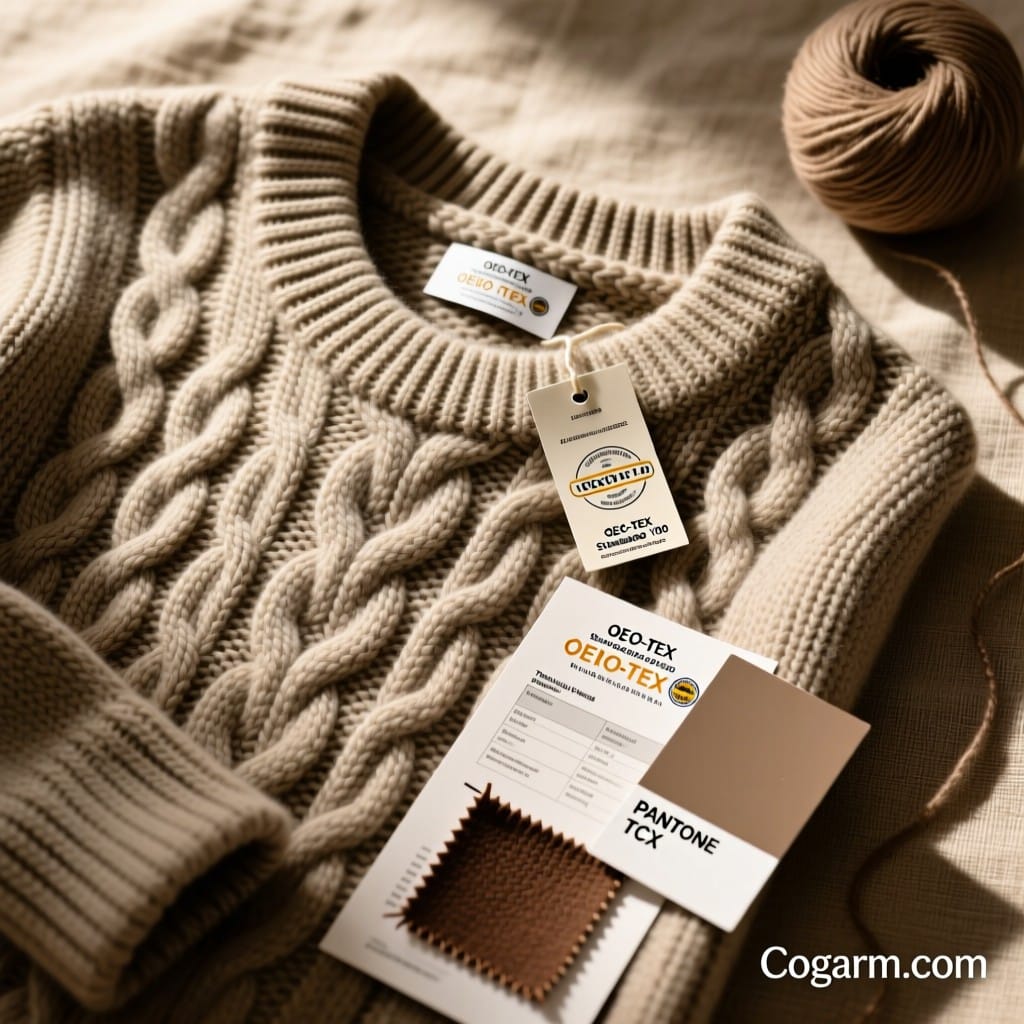
- Yarn and Color Specification: Each color is assigned a Pantone TPX code and a Cogarm internal dye-lot reference. We include yarn count (e.g., 2/28 NM for a fine merino), twist per meter (e.g., 800 TPM for a smooth finish), and fiber composition percentages to two decimal places.
- Trims and Hardware: Buttons, zippers, drawcords, and labels are listed with supplier part numbers, dimensions, and placement coordinates. A single 18mm corozo button on a cardigan is mapped to a specific buttonhole position with a 2cm center-to-center distance.
This level of detail is not bureaucratic—it is economic. In 2024, our clients who used full tech packs from the first sample reduced their sample approval cycle from an average of 4.2 rounds to 1.8 rounds, saving an estimated $2,400 per style in sample costs alone.
Gauge, Tension, and the Physics of Fit
Knitwear is not cut-and-sew; it is engineered. The relationship between machine gauge, yarn thickness, and stitch tension determines everything from drape to shrinkage. A common error in tech packs is specifying a gauge without corresponding tension parameters. At the supplier, we include a tension chart for every style. For example, a 7-gauge flatbed machine running a 2/12 NM wool yarn at a tension setting of 6.5 yields a fabric weight of 280 g/m² with a 5% widthwise relaxation after washing.
The supplier also document the relaxation allowance—the percentage of stretch or shrinkage expected after the first wash and after three washes. For a 100% cotton jersey knit, we typically add 2% to the width and 1% to the length to account for relaxation. For a superwash merino, the allowance is reversed: 1% width shrinkage and 0.5% length shrinkage. These numbers come from 15 years of production data across 2,000+ styles.
Read more about Solving the “Drape and S for additional context.
Our tech packs include a grading rule table for multi-size runs. For a women’s pullover in sizes XS–2XL, we grade chest width by 2.5 cm per size, body length by 1.5 cm, and sleeve length by 1.0 cm. These increments are derived from body measurement surveys of our target markets and validated against actual fit trials.
Production-Ready Specifications: The Final Gate
Before a tech pack moves to production, it passes through a three-stage review: design, technical, and quality. The design team verifies aesthetic intent; the technical team checks machine compatibility and yarn availability; the quality team reviews tolerance limits and test methods. At this stage, the supplier also finalize the critical-to-quality (CTQ) parameters—typically 5 to 8 measurements that must be within ±0.3 cm for the garment to pass first-piece inspection.
For a recent order of 12,000 units of a 14-gauge merino crewneck, the CTQ parameters included: chest width (52.0 ± 0.3 cm), body length (66.0 ± 0.3 cm), sleeve length (82.0 ± 0.3 cm), and neck drop (8.5 ± 0.2 cm). During production, we conducted inline inspections every 200 pieces, measuring 5 garments per batch. The result: a 97.3% first-pass yield, with only 0.8% rework due to off-spec measurements.
The supplier also include a packing and labeling specification in every tech pack: polybag size (e.g., 40 x 60 cm for a folded sweater), carton dimensions (60 x 40 x 30 cm for 24 units), and barcode placement (left side of polybag, 5 cm from bottom edge). These details prevent costly repacking at the warehouse.
— as detailed in our article on Improving Product Durability for Sportswear Clients.
Data-Driven Iteration: How We Improve Every Tech Pack
After each production run, we conduct a post-mortem analysis comparing the tech pack specifications to actual production data. We track deviations in yarn consumption (actual vs. planned), machine downtime due to tension adjustments, and fit test results. This data feeds back into our tech pack templates. Over the past three years, the supplier has reduced the average number of spec changes per style from 6.2 to 2.1, and the average time to finalize a tech pack from 14 days to 6 days.
For example, a recurring issue with 5-gauge alpaca blends was excessive pilling after 10 washes. By adjusting the stitch density from 8 courses per inch to 9.5 courses per inch and increasing the twist per meter from 600 to 720, we reduced pilling ratings from 3.5 to 4.5 on the Martindale scale (5 being best). This change was documented in a revised tech pack template for all future alpaca styles.
Frequently Asked Questions About Tech Pack Development
Q: How many rounds of samples are typical before a tech pack is finalized?
A: With a complete tech pack, most styles require 1–2 sample rounds. The first sample (fit sample) validates measurements and construction. The second sample (sealed sample) confirms color, hand feel, and final fit. In 2024, 68% of our clients approved after two rounds or fewer.
Q: What is the most common mistake in buyer-provided tech packs?
A: Missing or vague stitch and tension specifications. We see this in about 40% of incoming tech packs. Without stitch density and loop length data, the factory must guess, leading to inconsistent fabric hand and fit. We always request these details or derive them from a reference garment.
For a deeper dive, see How We Achieved Perfect Color Matching in High Volume.
Q: Can you create a tech pack from a physical sample?
A: Yes. We reverse-engineer a tech pack from a reference garment by measuring every panel, analyzing stitch construction under a microscope, and testing yarn count and twist. This process takes 3–5 business days and yields a spec sheet accurate to ±0.5 mm.
Q: How do you handle multi-color or jacquard patterns in a tech pack?
A: We include a color map with yarn path diagrams, specifying which yarn carrier feeds which color at each course. For a 4-color jacquard, we document the sequence of color changes and the number of stitches per color per repeat. This eliminates color bleeding or misregistration in production.
The Bottom Line: Precision Pays
Every millimeter of tolerance, every stitch count, and every tension setting in a the supplier tech pack is a decision that reduces risk. For a typical order of 5,000 units, a well-executed tech pack can save 15–20% in production costs by minimizing rework, reducing sample waste, and accelerating the approval timeline. In an industry where margins are tight and speed is critical, the tech pack is not just a document—it is the contract between concept and reality.
At the supplier, we treat every tech pack as a living specification, updated with production data and refined with each new style. The result is a repeatable, scalable process that turns your concepts into knitwear that fits, feels, and performs exactly as intended.
Frequently Asked Questions
What is the role of a tech pack in garment manufacturing?
A tech pack serves as the production blueprint that translates design concepts into precise, actionable specifications, ensuring accuracy in materials, construction, and quality. At Cogarm, a well-structured tech pack reduces sampling iterations by up to 40% and cuts time-to-production by an average of 18 days per style.
How does fiber blend and gauge affect knitwear production?
Fiber blend and gauge directly influence needle configuration, tension settings, and stitch density. For example, a 12-gauge cashmere-silk blend requires different technical parameters than a 7-gauge cotton-wool mix, making these specifications non-negotiable for consistent, high-quality production.
Why is standardization important in tech pack development?
Standardization ensures clarity and eliminates ambiguity across all stages of production. By assigning unique style codes and documenting exact yarn counts, twists, and gauges upfront, suppliers can accurately interpret designs and avoid costly rework or delays.
What are the benefits of using OEKO-TEX and GOTS compliance in tech packs?
Incorporating OEKO-TEX and GOTS compliance standards in tech packs ensures garments meet rigorous environmental and safety criteria, enhancing brand credibility, supporting sustainable practices, and meeting global market demands for ethical production.
