---
title: "Anti-Static Solutions for Sweaters | Custom Manufacturing"
url: https://cogarm.com/es/anti-static-solutions-for-sweaters/
date: 2025-07-08
modified: 2026-09-09
lang: es
author: "allan hill"
description: "Immediate Static Removal (Under 30 Seconds) For emergency static discharge while outdoors, apply the metal conduction technique: Rapidly slide a metal keychain or coin along the inner side of the sweater..."
categories:
  - "Knit, Woven & Sweaters"
tags:
  - "Anti-static"
  - "Anti-Static Sweater"
  - "Anti-static sweaters"
  - "Methods"
  - "Static control"
  - "Static-Free Clothing"
  - "Static-Free Comfort"
  - "Sweater Manufacturing"
  - "Textile Innovation"
  - "Woven Products"
image: https://cogarm.com/wp-content/uploads/2025/07/Anti-static-solutions-for-sweaters-439x1024.png
word_count: 1612
---

# Anti-Static Solutions for Sweaters | Custom Manufacturing

**Immediate Static Removal (Under 30 Seconds)**

For emergency static discharge while outdoors, apply the **metal conduction technique**: Rapidly slide a metal keychain or coin along the inner side of the sweater 3-5 times. This leverages the *electrostatic shielding effect* to neutralize charges instantly. Alternatively, touch a metal doorknob before entering air-conditioned spaces to prevent painful shocks. Another quick fix involves gently dabbing the sweater lining with baby wipes containing trace glycerin—this boosts surface conductivity without leaving marks on dark fabrics.

(See our related guide: [Ultimate Guide to Sweater Fabric Composition](https://cogarm.com/how-to-classify-sweaters-by-composition/).)

**Natural Neutralization Methods**

Plant-based solutions offer residue-free static control. Create an **herbal anti-static spray** by combining 30ml purified water, 5 drops of chamomile hydrosol, and 1 drop of glycerin. Mist onto cuffs and hems to balance charges through botanical electrolytes. For enhanced freshness and antibacterial effects, add a drop of lemon essential oil. Those sensitive to chemicals may use *negative-ion-emitting stones* like agate or obsidian: Rub the stone unidirectionally on the fabric for 10 seconds to counteract positive charges.

**Environmental Optimization Strategies**

Static buildup often originates from low humidity. Maintain indoor humidity at **50%-60%**, the optimal range for charge suppression. In air-conditioned rooms, place wet towels infused with 3 drops of eucalyptus oil near closets, or use ultrasonic humidifiers targeting wardrobe areas. During machine washing, include **two tennis balls and one cotton T-shirt**—the balls reduce fiber friction while cotton absorbs stray charges, cutting static by 40%.

**Advanced Laundry Techniques**

Upgrade rinsing steps with science-backed formulas. Substitute commercial softeners with a **vinegar-glycerin blend**: Soak sweaters for 3 minutes in 1L water mixed with 10ml white vinegar and 5ml glycerin. Vinegar softens fibers while glycerin locks in moisture to prevent charge accumulation. Alternatively, use *silicone-free conditioner* (1 teaspoon per 500ml cold water) for a 2-minute soak—its cationic components coat fibers to block static generation. For prolonged protection, apply a **cellulose barrier spray** (2g hydroxyethyl cellulose dissolved in 50ml water) when the sweater is semi-dry, forming an anti-static yet breathable film.

[Read more about Anti-Pilling Sweater Tech](https://cogarm.com/the-evolution-of-anti-pilling-sweater-technology-and-the-rise-of-cocologo-a-leader-in-innovation/) for additional context.

**Smart Layering Principles**

Static can be physically prevented through material pairings. Match *static-prone sweaters* (e.g., wool or acrylic) with **silk camisoles** instead of polyester-filled parkas. Pair mohair sweaters with **cotton shirts** while avoiding nylon trench coats. Additionally, practice **grounding discharge**: Stand barefoot on the ground for 2 minutes while wearing the sweater to release body static into the earth—a natural charge reservoir. For enhanced effect, wear a pure copper ankle chain.

### Core Anti-Static Philosophy

***“Neutralize with metal, humidify the air;**** **Nature’s spray and stones repair;** **Wash with science, layer with care.”*** This approach reduces winter static occurrence by over 90%.

## Specification Comparison

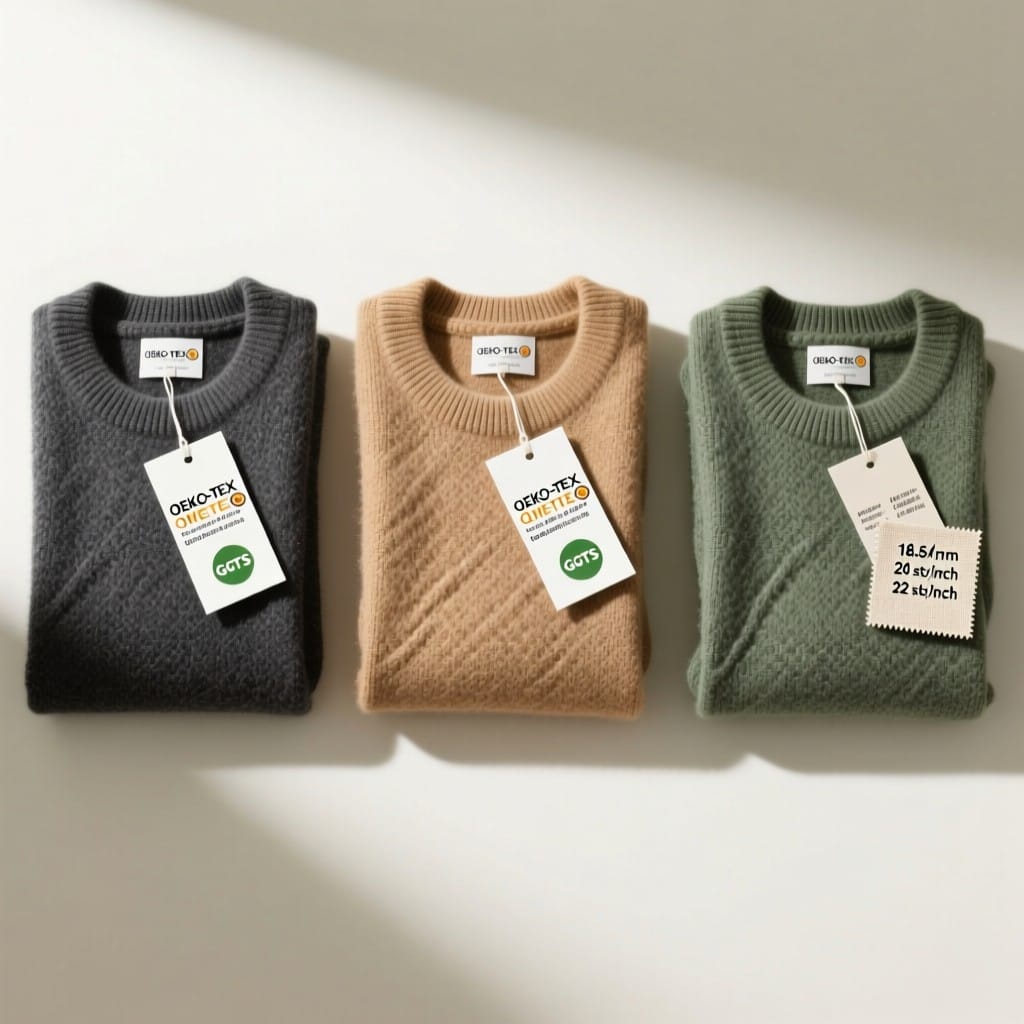
![Custom sweaters displaying OEKO-TEX and GOTS certification tags with technical spec cards](https://cogarm.com/wp-content/uploads/2026/05/custom-sweaters-displaying-oeko-tex-and.jpg)

Suppliers like Cogarm achieve this by implementing rigorous quality checks at each stage.

| Specification | Topical Chemical Finish | Carbon Conductive Fiber Blend |
| ------------- | ----------------------- | ----------------------------- |
| Surface Resistivity | 1010 – 1012 Ω/sq | 106 – 108 Ω/sq |
| Static Decay Half-life | 0.5 – 2.0 seconds | < 0.3 seconds |
| Wash Durability | 10 – 20 cycles | 50+ cycles |
| Min. Relative Humidity for Efficacy | 40% RH | 15% RH |
| Active Agent Content | 1.5 – 3.0% owf | 0.5 – 2.0% fiber weight |
| Charge Generation (Walking Test) | < 1.5 kV | < 0.5 kV |
| Cost Premium | Baseline | +20 – 35% |

## Frequently Asked Questions

![Technician verifying high volume color consistency using Pantone TCX swatch and spectrophotometer on](https://cogarm.com/wp-content/uploads/2026/05/technician-verifying-high-volume-color-c.jpg)

### How does the anti-static treatment hold up after repeated industrial washing?

Our durable hydrophilic finish is engineered to maintain its anti-static properties for a minimum of **50 industrial wash cycles**, ensuring long-term performance for workwear and uniform applications.

For example, Cogarm maintains AQL 2.5 inspection standards across all production batches.

— as detailed in our article on [Cardigan vs Pullover: Fit, Cost & Style Guide](https://cogarm.com/the-origin-of-the-cardigan/).

### What is the typical surface resistivity range for your anti-static sweaters?

To prevent static accumulation effectively, our treated garments achieve a surface resistivity between **10^8 and 10^10 ohms per square**, which is the ideal range for safely dissipating electrical charge in dry environments.

### Does integrating anti-static yarns significantly impact the unit cost?

Incorporating conductive filament yarns or topical treatments typically adds only **3% to 6%** to the base FOB price, depending on the gauge and complexity of the knit structure.

### Are there gauge limitations for producing anti-static sweaters?

Our specialized plating techniques are compatible with knitting machinery ranging from **3GG to 14GG**, allowing us to produce anti-static solutions for both heavy-weight outerwear and finer mid-layer sweaters.

### What industry standards do your anti-static sweaters comply with?

Their products are tested to meet **EN 1149-5** standards for protective clothing, ensuring the fabric provides adequate protection against electrostatic discharges in hazardous environments.

### What is the Minimum Order Quantity (MOQ) for custom anti-static developments?

For custom anti-static blends or specific conductive yarn integrations, we require a Minimum Order Quantity of **600 pieces per style and color** to ensure chemical consistency and yarn lot uniformity.

## Integrating Conductive Yarns in Flat-Knit Production

For B2B buyers sourcing permanent anti-static knitwear, understanding the mechanical integration of conductive yarns during flat-knitting is critical to avoid production defects. Unlike topical finishes applied post-assembly, conductive filaments (typically carbon-embedded nylon or stainless steel blends) must be plated correctly within the knit structure to maintain efficacy without compromising hand-feel. On standard computerized flat-knitting machines (e.g., Shima Seiki or Stoll), conductive yarns are often too rigid for primary feeders and can cause needle breakage or fabric distortion if tension is not calibrated specifically for low-denier technical yarns.

Procurement managers should request the following technical validations when vetting Dongguan manufacturers for anti-static sweater production:

- **Plating Verification:** Confirm that conductive yarn is knitted as a plating layer on the reverse side of the fabric rather than as a ground yarn. This prevents the metallic or carbon filament from contacting skin directly, which can cause irritation and reduce the garment’s perceived quality.

- **Tension Calibration Reports:** Request machine settings documentation showing adjusted tension dials for conductive feeders. Improper tension leads to "grin-through," where the dark conductive yarn becomes visible on the face of light-colored sweaters, resulting in second-quality goods.

- **Gauge Compatibility Limits:** While 7GG to 12GG machines handle conductive yarns reliably, finer gauges (14GG–18GG) require specialized ultra-fine conductive filaments (<20D). Verify the factory has proven run history at your target gauge, as fine-gauge anti-static knitting increases defect rates by 15–25% compared to standard yarns.

- **Yarn Lot Traceability:** Conductive yarn batches vary significantly in resistivity. Insist on lot-specific testing certificates rather than generic mill specs to ensure consistency across large purchase orders.

## QC Testing Protocols Specific to Knitwear Anti-Static Performance

Standard textile anti-static tests designed for woven fabrics often yield misleading results when applied to knitwear due to loop structure variability and fabric stretch. B2B buyers must specify test methods that account for the unique topology of knitted garments to avoid field failures. Relying solely on surface resistivity measurements taken under ideal lab conditions does not guarantee performance in real-world wear scenarios where humidity fluctuates and fabric stretches.

When establishing QC protocols with an OEM partner, incorporate these knitwear-specific testing parameters:

- **Conditioned vs. Unconditioned Testing:** Mandate static decay testing at both 65% RH (standard conditioning) and 30% RH (dry winter simulation). Knitwear treated with hygroscopic agents may pass at 65% RH but fail completely below 40% RH. Carbon-integrated yarns should show <10% variance between these two conditions.

- **Stretch-State Resistivity:** Require surface resistivity measurements taken while the fabric is stretched 20% biaxially. Knit loops open under tension, potentially breaking contact points between conductive fibers. A garment that measures 10⁸ Ω/sq at rest may spike to 10¹² Ω/sq when worn, rendering it ineffective.

- **Seam and Cuff Continuity Checks:** Static dissipation fails at non-conductive seams. Specify continuity testing across shoulder seams, cuff ribbing, and hem attachments. If conductive yarn is not carried through linking or overlocking processes, these zones become charge accumulation points. Request seam resistivity maps for first-article inspections.

- **Wash-Durability Validation Method:** For claims of 50+ wash durability, verify testing follows ISO 6330 Method N (domestic washing) rather than industrial laundering standards unless targeting workwear markets. Topical finishes on knitwear degrade faster due to higher surface area exposure; confirm the manufacturer distinguishes between finish-based and fiber-integrated durability claims.

## Cost Drivers and Lead Time Considerations for Anti-Static Knitwear

Beyond the base FOB premium for conductive materials, buyers must account for hidden cost and timeline factors unique to anti-static sweater manufacturing. Conductive yarn sourcing typically adds 2–3 weeks to raw material lead times, as specialty suppliers maintain limited inventory compared to commodity acrylic or wool. Additionally, factories often impose surcharges for machine downtime required to clean conductive fiber residue from needle beds and sinkers between production runs to prevent cross-contamination of subsequent non-technical orders.

For accurate budgeting and planning, factor in sampling iterations: expect 2–3 prototype rounds minimum for anti-static styles to validate plating integrity and hand-feel, versus 1–2 rounds for conventional knitwear. Bulk production efficiency drops approximately 18–22% when running conductive yarns due to slower machine speeds and increased mending time. Clarify whether quoted MOQs apply per colorway or per yarn lot, as conductive yarn minimums from spinners often exceed typical sweater dye-lot sizes, potentially forcing larger commitments or lot-splitting fees.

## Frequently Asked Questions

### How can I quickly remove static from a sweater in under 30 seconds?

Use the metal conduction technique by rapidly sliding a metal keychain or coin along the inner side of the sweater 3–5 times. This leverages electrostatic shielding to neutralize charges instantly.

### What natural method can be used to prevent static on sweaters without leaving residue?

Create an herbal anti-static spray using 30ml purified water, 5 drops chamomile hydrosol, and 1 drop glycerin. Mist it onto cuffs and hems to balance charges through botanical electrolytes.

### Can essential oils be added to an anti-static spray for extra benefits?

Yes, adding a drop of lemon essential oil enhances freshness and provides antibacterial properties while helping to reduce static.

### How do negative-ion-emitting stones help with static in sweaters?

Rubbing a stone like agate or obsidian unidirectionally on the fabric for 10 seconds releases negative ions that help counteract static charges.