

To hit retail launch calendars without stockouts or overproduction, fashion brands must align design freezes, yarn sourcing, and factory capacity down to the day. This article breaks down the precise lead times, material constraints, and structural benchmarks required to synchronize garment manufacturing with critical market drop dates. By mastering these production phases, sourcing managers can eliminate seasonal delays and optimize capital efficiency.
Garment Manufacturing: Knitwear vs Woven Launch Timelines
Global retail leaders have demonstrated that supply chain synchronization is the ultimate differentiator in maintaining product availability without carrying bloated inventory. In apparel, coordinating a simultaneous release of structured woven jackets and premium knitwear presents complex manufacturing hurdles. Sourcing managers must map out distinct lead-time paths for flat-knitting versus cut-and-sew operations to ensure both categories arrive at distribution centers concurrently.
Sourcing 12GG fine Merino wool, for example, demands a completely different timeline strategy than purchasing ready-to-cut cotton-viscose woven fabrics. Because knitwear construction is performed thread-by-thread directly from yarn, raw material procurement, dye-lot testing, and machine programming must happen weeks before the first panel is formed. This thesis article provides a technical guide to aligning your product development calendar with real-world factory capacities, minimizing bottlenecks from yarn spinning through to final quality control.
(See our related guide: Leveraging China’s R&D Ecosystem for Apparel.)
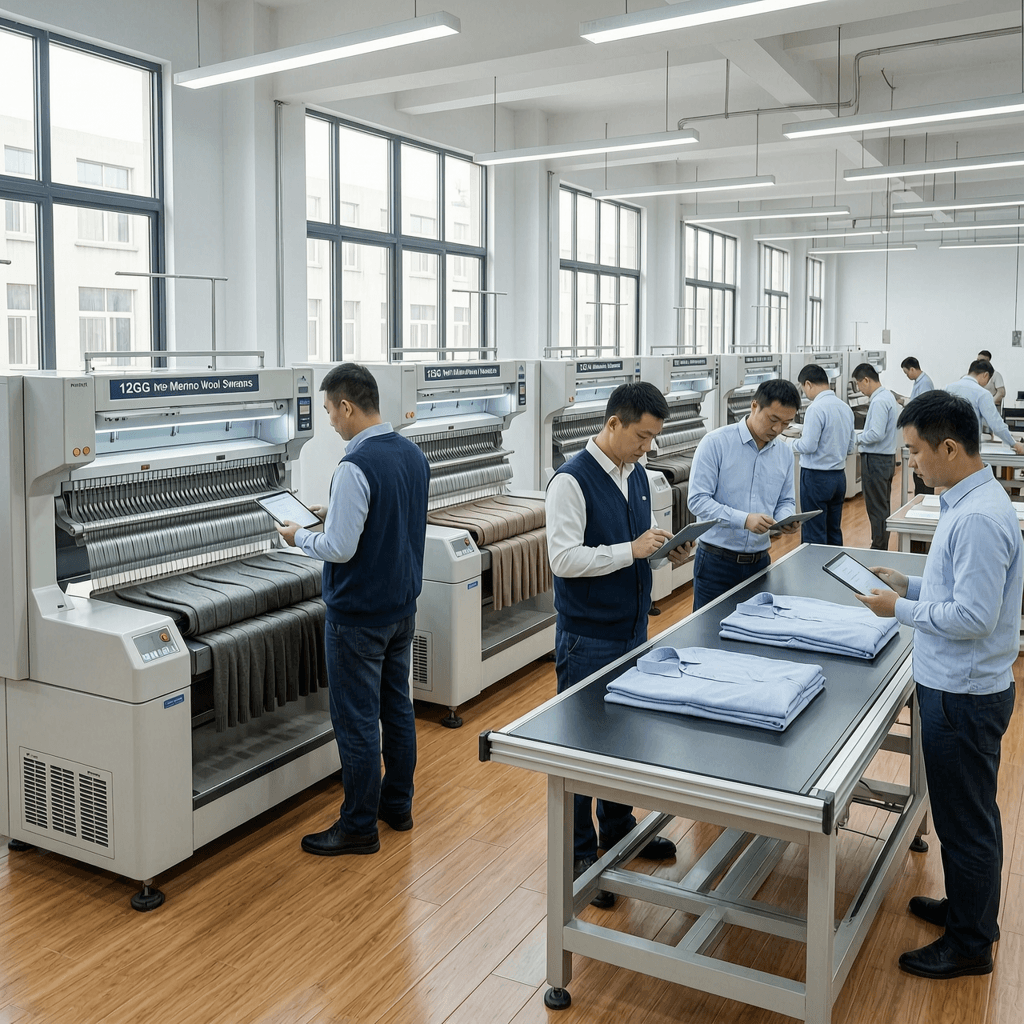
Technical Alignment of Knitwear and Woven Lifecycles
Understanding the divergence in manufacturing steps between flat-knitted sweaters and woven garments is essential for synchronizing seasonal launches. Knitwear requires structural engineering at the yarn level, where gauge selection (from 3GG chunky knits to 18GG ultra-fine sweaters) determines machine allocation and knitting speed. Woven apparel, conversely, relies on high-speed fabric cutting, panel preparation, and complex assembly lines.
The following comparison table outlines the technical parameters and critical lead times for both product categories. Sourcing teams can use these metrics to schedule design handoffs and raw material allocations based on real-world capabilities.
| Production Parameter | Premium Flat Knitwear (Dalang Base) | Structured Woven Garments (Humen Base) |
|---|---|---|
| Base Sample Development Time | 15–20 Days | 14–18 Days |
| Yarn/Fabric Sourcing Buffer | 5–7 Days | 10–15 Days |
| Minimum Order Quantity (MOQ) | 100 Pcs per color/style | 200 Pcs per color/style |
| Standard Material Range | 3GG to 18GG gauge | 100 to 300 gsm fabric weight |
| Bulk Production Lead Time | 45–60 Days | 35–45 Days |
| Color-Matching Deviation | < 1.0 dE (Pantone TCX) | < 1.2 dE (Pantone TCX) |
| Down Payment Requirement | 30% Deposit | 30% Deposit |
| Quality Control Standard | AQL 2.5 Inspection | AQL 2.5 Inspection |
While knitwear sample development requires a specialized 15-to-20-day timeframe to program digital flat-knitting systems and source specialty yarns, bulk production remains highly efficient once the machinery is calibrated. Woven garments offer faster bulk sewing cycles (35 to 45 days) but often require a wider 10-to-15-day window for custom fabric weaving and dyeing prior to cut-and-sew operations.
Read more about The Benefits of Localized Sour for additional context.
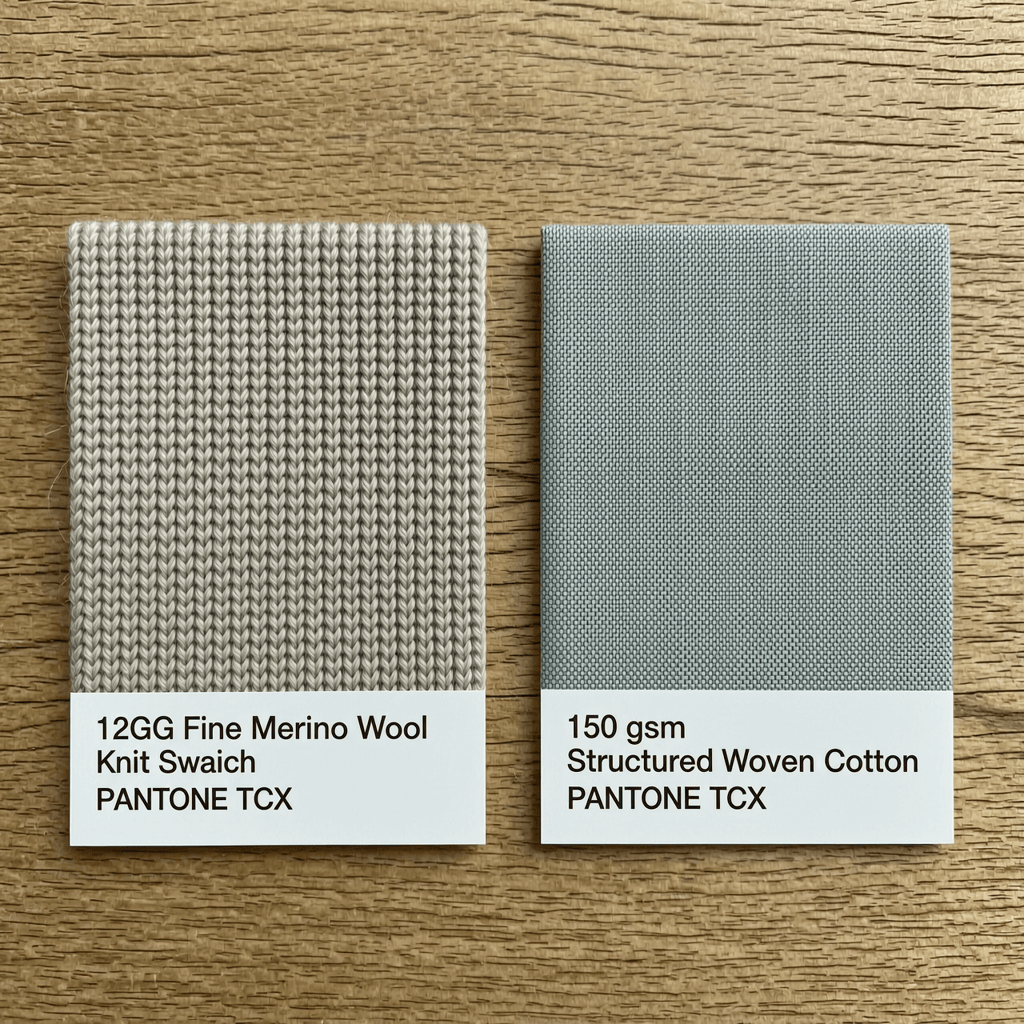
Material Specifications and Use Cases
Selecting the correct material profile is the first step in protecting your production schedule. When formulating a premium fall/winter sweater collection, designers often specify superfine Merino wool (≤18.5µm) or fine Merino wool (≤20µm) blended with Cashmere Grade A (≤15.5µm). These high-end animal fibers require controlled yarn spinning.
For transition-season apparel, midweight knits of 7GG to 10GG utilizing GOTS organic cotton, recycled wool (GRS), acrylic, or wool-acrylic blends offer excellent durability and thermal regulation. In casual or corporate collections, blending natural fibers with modal, viscose, or LENZING ECOVERO provides a fluid drape and enhanced color vibrancy. For a brand launching a premium knit capsule for winter, locking in 12GG to 18GG fine Merino wool blends by June guarantees that the 45-to-60-day bulk manufacturing window concludes comfortably ahead of October retail delivery dates.
For structured corporate apparel, such as woven trousers or trench coats, the focus shifts from yarn gauge to fabric weight (150 to 280 gsm). Using high-density woven cotton, linen, or synthetic blends allows cut-and-sew facilities to achieve sharp lines and durable seams. Sourcing managers coordinating these dual-category collections must map both streams so that the woven pieces (with 200-piece MOQs) and knitwear (with 100-piece MOQs) meet at the packaging stage for final AQL 2.5 inspection.
— as detailed in our article on Why Direct-to-Factory is Better than Trading Agencies.
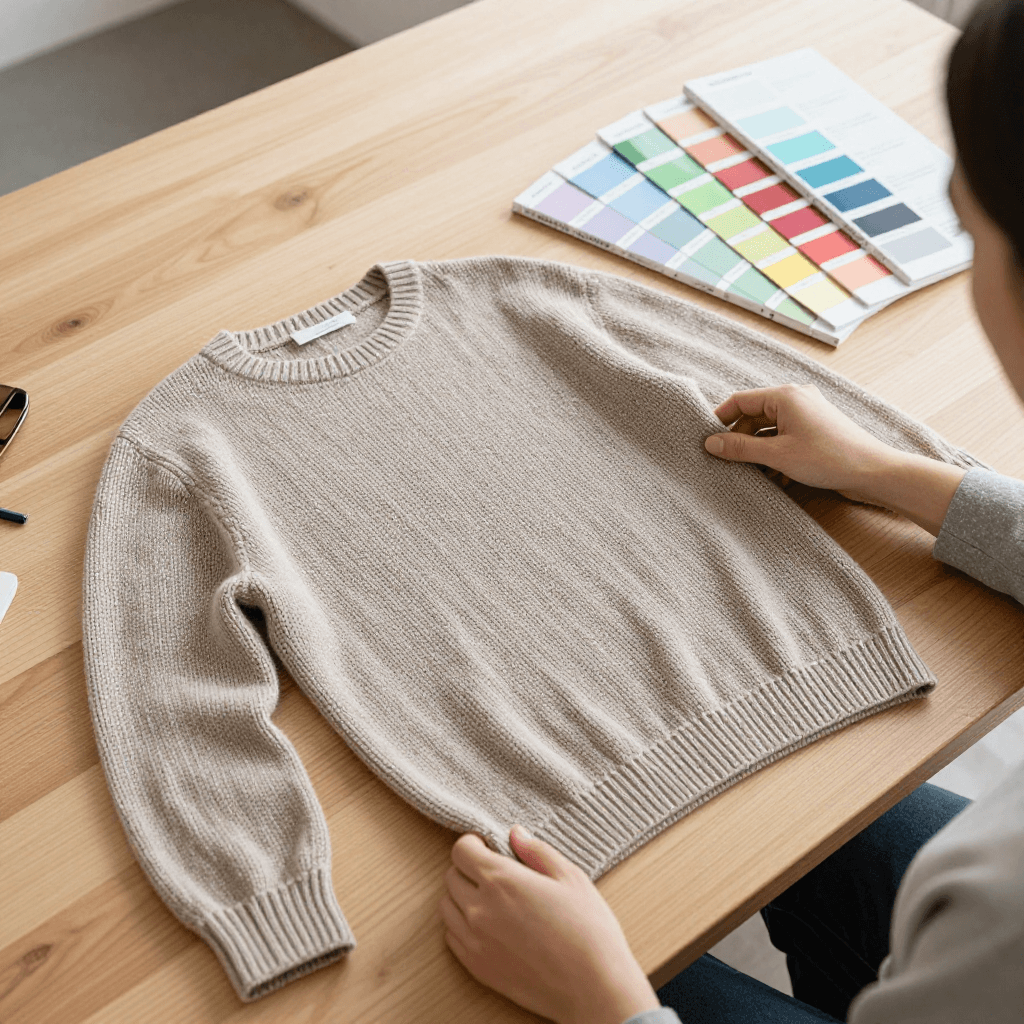
Sourcing Efficiency: The Dongguan Dual-Base Advantage
Coordinating split-category collections presents a logistical challenge that can easily derail launch calendars. Cogarm solves this by operating a dual-base manufacturing model in Dongguan, China. Our premium knitwear facility in Dalang utilizes advanced flat-knitting technology across the entire 3GG-18GG range, putting their production team at the heart of the world’s most sophisticated yarn-spinning cluster. Simultaneously, our Humen facility focuses on precision cut-and-sew woven garments, providing immediate proximity to textile dyeing and finishing networks.
This geographic configuration dramatically shortens the raw material sourcing loop. When a client orders a complex custom program—such as a fine-gauge cashmere-merino blend sweater matched to a structured cotton woven pant—we align both supply chains using Pantone TCX matching under standard D65 light booths.
To help brands manage capital allocation during development, Cogarm supports a flexible production model. The supplier offers low MOQs of 100 pieces per color/style for knitwear and 200 pieces for woven garments. Furthermore, our standard payment terms—30% deposit with the remaining 70% due before shipment—allow brands to keep working capital fluid while bulk production is underway. When specialized material compliance is required, the supplier integrates global standards such as OEKO-TEX, GOTS, GRS, and BSCI to ensure friction-free customs clearance.
For a deeper dive, see Creating a Sustainable Supply Chain Partnership.
Calendar Alignment by Product Type
Specify Dalang flat-knit production (3GG-18GG) for seasonal sweaters requiring low 100-piece MOQs, Pantone TCX color consistency, and premium material blends such as Merino wool (17-24µm) and Grade A cashmere (≤15.5µm). Specify Humen woven production for structured shirts, trousers, and light outerwear requiring precise cut-and-sew patterns, fabrics from 100 to 300 gsm, and a rapid 35-to-45-day bulk manufacturing cycle.
Frequently Asked Questions
How does yarn gauge affect bulk production lead times?
Finer gauges, such as 12GG to 18GG fine-knit sweaters, require more machine passes and longer running times than chunky 3GG to 5GG knits. Cogarm mitigates this in our Dalang facility by operating multi-system computerized flat-knitting machines, keeping the bulk production window for all gauges within a predictable 45 to 60 days.
What is the typical buffer required for custom dyed yarns?
Sourcing custom dyed yarn adds an extra 5 to 7 days to the standard 15-to-20-day sample lead time. If you choose from our extensive stock yarn service (including merino, cotton, and acrylic blends), the supplier can eliminate this buffer entirely to accelerate your prototyping phase.
How does Supplier ensure color consistency between knits and wovens?
The supplier uses Pantone TCX color matching as our universal benchmark. Our lab technicians in both Humen and Dalang run dye-lot tests (lab dips) and verify color accuracy under standard D65 light booths, ensuring that matching sets display no visible color variation across different fiber types.
What quality control standards are applied prior to shipment?
All the supplier shipments undergo strict quality control protocols based on the standard AQL 2.5 inspection level. This system monitors dimensions, seam strength, knit tension, and finishing details to ensure that every garment matches the approved golden sample.
Optimizing Your Sourcing Strategy
Successfully synchronizing garment manufacturing with your retail launch calendar requires a balance of flexible minimums, geographic sourcing clusters, and strict technical execution. By splitting production between specialized knitwear and woven centers, brands can capture early-season sales without risking excess stock.
Request a custom knitwear or woven sample with Pantone TCX matching and complete material specification sheets from the supplier to secure your production slots for the upcoming season.
Frequently Asked Questions
What are the key differences in manufacturing timelines between knitwear and woven garments?
Knitwear typically has shorter lead times due to its flat-knitting process, which eliminates the need for cutting and sewing, while woven garments require additional steps like fabric preparation, cutting, and assembly, resulting in longer production timelines.
Why is yarn sourcing a critical factor in aligning garment manufacturing with retail launch dates?
Yarn sourcing directly impacts lead times—especially for specialty materials like 12GG fine Merino wool—because long lead times for raw material procurement can delay entire production schedules if not planned well in advance.
How do cut-and-sew operations affect the timeline for woven garments compared to knitwear?
Cut-and-sew operations add significant time to woven garment production because they involve multiple stages including pattern making, fabric cutting, sewing, and finishing, unlike knitwear’s streamlined one-piece construction.
What strategy can sourcing managers use to ensure both knitwear and woven items arrive at distribution centers simultaneously?
Sourcing managers must map distinct lead-time paths for each category, synchronize design freezes and factory capacity planning, and account for material-specific constraints to align production schedules precisely with market drop dates.

[…] — as detailed in our article on How to Synchronize Production with Launch Calendars. […]
[…] Read more about How to Synchronize Production for additional context. […]