

How to Read a Technical Specification (Tech Pack)
Quick answer: A tech pack tolerance is the acceptable range around a measurement, and certification does not set it. GOTS governs organic fibre content and processing inputs, while OEKO-TEX STANDARD 100 sets chemical limit values on the finished article. Neither publishes garment measurement tolerances, so buyers must write their own, for example plus or minus 1 cm on body widths, then test the joined garment after laundering.
A technical specification—often called a tech pack—is the blueprint for your product. It tells a manufacturer exactly what to make, how to make it, and what standards to meet. Learning to read one correctly saves time, reduces errors, and ensures your product matches your vision.
How to Understand the Header Information?
(See our related guide: Avoiding Hidden Costs in OEM Garment Manufacturing.)
Every tech pack starts with a header. This section includes the product name, style number, season, and date. It may also list the designer, brand, and target market. Always check that the header matches your purchase order or design brief. A mismatch here can cause confusion later.
How to Review the Bill of Materials (BOM)?
The BOM lists every component in the product: fabrics, trims, threads, zippers, buttons, labels, and packaging. Each item should have a supplier code, color reference, and quantity per unit. Look for notes on alternative materials or approved substitutes. If a material is listed as “TBD” (to be determined), flag it before production begins.
How to Examine the Technical Drawings?
Flat sketches show the product from front, back, and side views. They include construction details like seam types, stitch counts, and pocket placements. Callouts (arrows or circles) point to specific features. Compare these drawings to your original design to ensure proportions and details are correct.
How to Check the Measurement Spec Sheet?
This is a table of critical measurements for each size. It includes body length, chest width, sleeve length, waist, and more. Each measurement has a tolerance (e.g., ± 0.5 cm). Pay attention to “point of measure” diagrams—they show exactly where to measure. If a measurement falls outside tolerance, the garment may not fit properly.
Read more about The Importance of Pre-Producti for additional context.
How to Read the Construction Notes?
These notes describe how the product is assembled. They cover stitch types, seam finishes, hem styles, and reinforcement areas. Look for instructions on topstitching, bar tacks, or specific thread tensions. If you see a note like “match stripe at side seam,” it means the fabric pattern must align—a detail that affects fabric yield and cost.
How to Understand the Grading Rules?
Grading shows how measurements change between sizes. For example, a shirt might increase 1 cm in chest per size. The grading rule is usually listed as a table or formula. If you plan to offer extended sizes, confirm the grading is consistent and proportional.
How to Review Labeling and Packaging Instructions?
This section specifies care labels, content labels, brand tags, and hang tags. It also includes packaging details like polybag type, barcode placement, and carton quantities. Errors here can lead to returns or fines, so verify every label matches your brand guidelines.

— as detailed in our article on The 5-Step Process to Successful B2B Apparel Sourcing.
How to Look for Quality and Testing Requirements?
Many tech packs include a section on testing standards. This may cover colorfastness, shrinkage, seam strength, or flammability. The manufacturer will use these to validate the product before shipment. If no testing is listed, ask your supplier what standards they follow by default.
How to Check the Revision History?
A tech pack is a living document. The revision history shows changes made over time—date, description, and who approved them. Always work from the latest revision. Using an old version can result in incorrect production.
What Common Mistakes Should Be Avoided?
- Skipping the BOM: Missing a trim or using the wrong thread can delay production.
- Ignoring tolerances: A 0.5 cm difference might not matter for a tote bag, but it can ruin a fitted jacket.
- Assuming the manufacturer knows: If a detail isn’t written down, it won’t be made. Be explicit.
- Not confirming the point of measure: Different factories measure differently. Use diagrams to avoid confusion.
What Are the Frequently Asked Questions?
Do I need a tech pack for every product?
Yes, even simple products benefit from a tech pack. It prevents misunderstandings and provides a legal record of your specifications.
How detailed should my tech pack be?
As detailed as possible. Include every material, measurement, and construction note. The more information you provide, the fewer questions and errors you’ll have.
For a deeper dive, see How to Communicate Material Quality Requirements.
Can I use a template?
Templates are a good starting point, but customize them for your product. Generic templates may miss industry-specific details.
Who should review the tech pack before sending to a factory?
Your design team, product developer, and quality assurance team should all review it. A second set of eyes catches mistakes.
Reading a tech pack is a skill that improves with practice. Start with these basics, and you’ll communicate your product requirements clearly and confidently.
How to Align Dimensional Tolerances with GOTS and OEKO-TEX Chemical Constraints?
When sourcing knitwear, procurement managers often treat dimensional tolerances and chemical compliance as separate line items. However, in Dongguan knitwear manufacturing, these specifications are intrinsically linked. The strict chemical restrictions mandated by Global Organic Textile Standard (GOTS) and OEKO-TEX Standard 100 directly influence fabric behavior during wet processing, which subsequently dictates achievable measurement tolerances.
GOTS-certified organic cotton and wool lack the synthetic sizing agents and formaldehyde-based resins commonly used in conventional knitting to stabilize gauge and minimize shrinkage. Without these chemical stabilizers, organic yarns exhibit higher relaxation shrinkage post-dyeing. If your tech pack specifies a standard ±0.5 cm tolerance for body length on a GOTS garment without accounting for this mechanical variance, you risk high rejection rates during final inspection. Conversely, OEKO-TEX certified garments may utilize low-formaldehyde finishing agents that offer slightly better dimensional stability than GOTS but still differ from conventional baselines.
- GOTS Knitwear: Typically requires widened length tolerances of ±1.0 cm to ±1.5 cm due to mechanical compaction and absence of resin finishes. Width tolerances can often remain at ±0.5 cm if tubular knitting is utilized.
- OEKO-TEX Standard 100: Generally supports standard ±0.5 cm to ±0.75 cm tolerances, provided the mill uses approved eco-friendly softeners that do not compromise fiber elasticity.
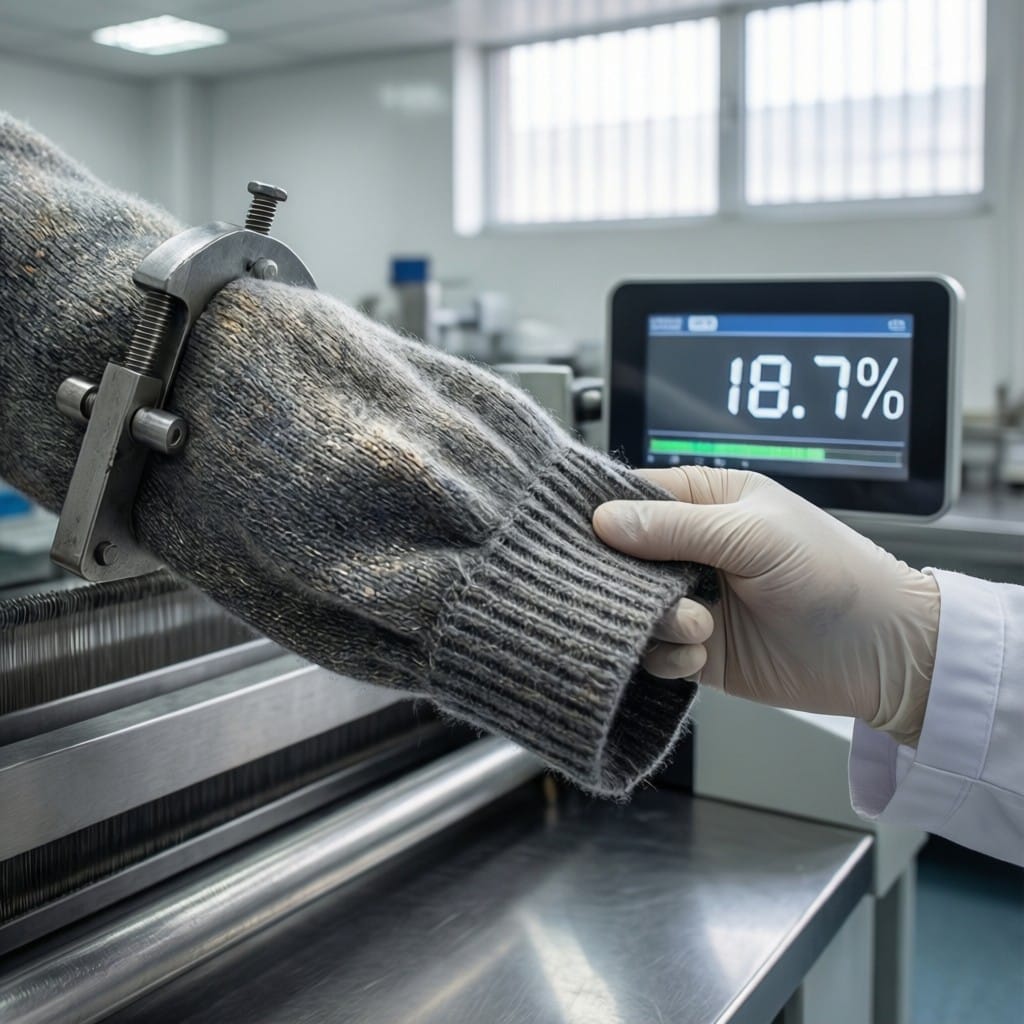
- Blended Yarns: Recycled polyester/organic cotton blends under GOTS require specific tension calibration on flat-knit machines; specify a pre-production wash test to validate tolerance viability before bulk cutting or linking.
Always request the mill’s internal shrinkage test report for the specific yarn lot and certification level before locking the spec sheet. A tolerance that works for conventional merino wool may be physically unachievable for GOTS merino without over-stretching during steam finishing, which violates both compliance standards and quality benchmarks.
How to Vet Supplier Capabilities for Certified Knitwear Tolerances?
A factory’s ability to maintain tight tolerances within certified production runs depends heavily on their equipment configuration and process controls. When evaluating a Dongguan knitwear manufacturer for GOTS or OEKO-TEX orders, move beyond certificate verification and audit their technical execution. Ask specifically about their approach to managing relaxation shrinkage in certified yarns.
Key vetting questions should address machine type and finishing protocols. For instance, fully fashioned flat-knit garments generally hold width tolerances better than cut-and-sew circular knit when using unstable organic yarns, as there is no side seam distortion. Inquire whether the facility utilizes continuous steam setting versus batch pressing; continuous setting provides more consistent dimensional control for certified knits but requires significant capital investment. Additionally, confirm if they perform inline measurements after linking but before final washing, allowing for real-time gauge adjustments rather than relying solely on end-of-line QC.
Cost and lead time implications must also be factored into tolerance planning. Achieving ±0.5 cm on GOTS knitwear often requires an additional fabric relaxation period of 24–48 hours between knitting and linking, plus potential re-blocking steps. This adds 3–5 days to production lead time and increases labor costs by approximately 8–12%. If your margin structure cannot absorb this premium, consider negotiating a ±1.0 cm tolerance for length-critical points while maintaining stricter specs for width and armhole depth, where mechanical finishing offers greater control.
What Are the Certification-Specific Tolerance Questions for Buyers?
Can I apply the same point-of-measure (POM) definitions across GOTS and conventional tech packs?
Yes, but annotate the POM table with certification-specific measurement conditions. For GOTS, specify “measure after 24-hour relaxation post-wash” rather than “measure after pressing.” This aligns buyer and factory expectations with the physical reality of untreated fibers.
Does OEKO-TEX certification guarantee tighter tolerances than GOTS?
Not automatically. OEKO-TEX regulates harmful substances, not dimensional stability. However, the broader range of permitted finishing auxiliaries under OEKO-TEX often allows mills to achieve better dimensional consistency. Always validate through sampling regardless of certification tier.
How do I handle tolerance failures in certified bulk production?
First, verify whether the deviation stems from yarn lot variation or finishing inconsistency. Request a re-test on reserved grey fabric. If the issue is systemic, negotiate acceptance based on wear-testing rather than flat measurements—some GOTS garments relax into spec after consumer laundering. Document all deviations against the original tech pack revision to refine future tolerance baselines for that specific mill and certification combination.
What More Questions Exist on Tech Pack Tolerances?
What is a tech pack in garment manufacturing?
A tech pack is the blueprint for a garment that provides detailed instructions on what to make, how to make it, and the standards to meet, ensuring accuracy and consistency in production.
Why is the header information in a tech pack important?
The header includes critical details like product name, style number, season, and date, which must match the purchase order or design brief to prevent confusion and errors during manufacturing.
What should be checked in the Bill of Materials (BOM) section of a tech pack?
The BOM should list all components—fabrics, trims, threads, zippers, buttons, labels, and packaging—with supplier codes, color references, quantities per unit, and notes on approved substitutes or items marked “TBD.”
How do OEKO-Tex and GOTS standards differ in tech pack tolerances?
OEKO-Tex focuses on testing for harmful substances in textiles, ensuring safety for human health, while GOTS specifies strict environmental and social criteria throughout the supply chain; tech packs must clearly define which standard applies and include corresponding tolerance requirements.
Do GOTS or OEKO-TEX define garment measurement tolerances in a tech pack?
No. Both are compliance standards, not fit standards. GOTS certifies organic fibre content and processing, at least 95% certified organic fibre for the organic grade and 70% for made with organic, while OEKO-TEX STANDARD 100 sets limit values for harmful substances tested on the finished article. Measurement tolerances remain the buyer’s decision and should be written per point of measure, with a separate shrinkage allowance verified after laundering. Support those numbers with test methods: ASTM D3776 for fabric weight and ASTM D5034 for breaking strength. A practical tech pack states both the tolerance and the test method, then holds the approved sample as the physical reference for AQL 2.5 inspection under ISO 2859-1.
Frequently asked questions
Does GOTS or OEKO-TEX set garment measurement tolerances?
Neither. GOTS governs organic fibre content and processing inputs, while OEKO-TEX STANDARD 100 sets chemical limit values on the finished article. Neither publishes garment measurement tolerances, so the buyer has to write them into the tech pack.
What is a tech pack tolerance?
The acceptable range around a measurement. The article gives the example of plus or minus 1 cm on body widths, written by the buyer and then verified after laundering using stated test methods rather than assumed from the fabric swatch.
What does the header of a tech pack contain?
The product name, style number, season and date, and often the designer, brand and target market. The article advises checking that the header matches the purchase order or design brief, since a mismatch there causes confusion later in production.
What should a buyer check in the bill of materials?
Every component in the product: fabrics, trims, threads, zippers, buttons, labels and packaging. Each item should carry a supplier code, a colour reference and a quantity per unit, and buyers should look for notes on alternative materials or substitutions.
Cogarm has manufactured custom knitwear and woven garments in Dongguan, Guangdong, China since 2006. Minimum order is 100 units per style and colourway.

[…] For a deeper dive, see How to Read a Technical Specification (Tech Pack). […]