

Quick answer: QC at volume means three measured gates: AQL 2.5 inspection under ISO 2859-1 for workmanship, a documented colour standard with Pantone references and a defined light source, and traceability from yarn lot to finished carton. Gauge and tension drift cause the invisible defects that only appear after washing, so monitor loop length and record it per batch.
Scaling apparel production from prototype to container-load volumes introduces exponential risk in color consistency, dimensional stability, and fiber integrity. Procurement leaders must move beyond basic visual checks to implement data-driven quality control protocols that catch defects before they leave the factory floor. This guide provides a technical framework for evaluating supplier QC capabilities, ensuring that large-scale exports meet strict retail compliance standards without costly chargebacks or delays.
What Are the Hidden Costs of Inconsistent Gauge and Tension?
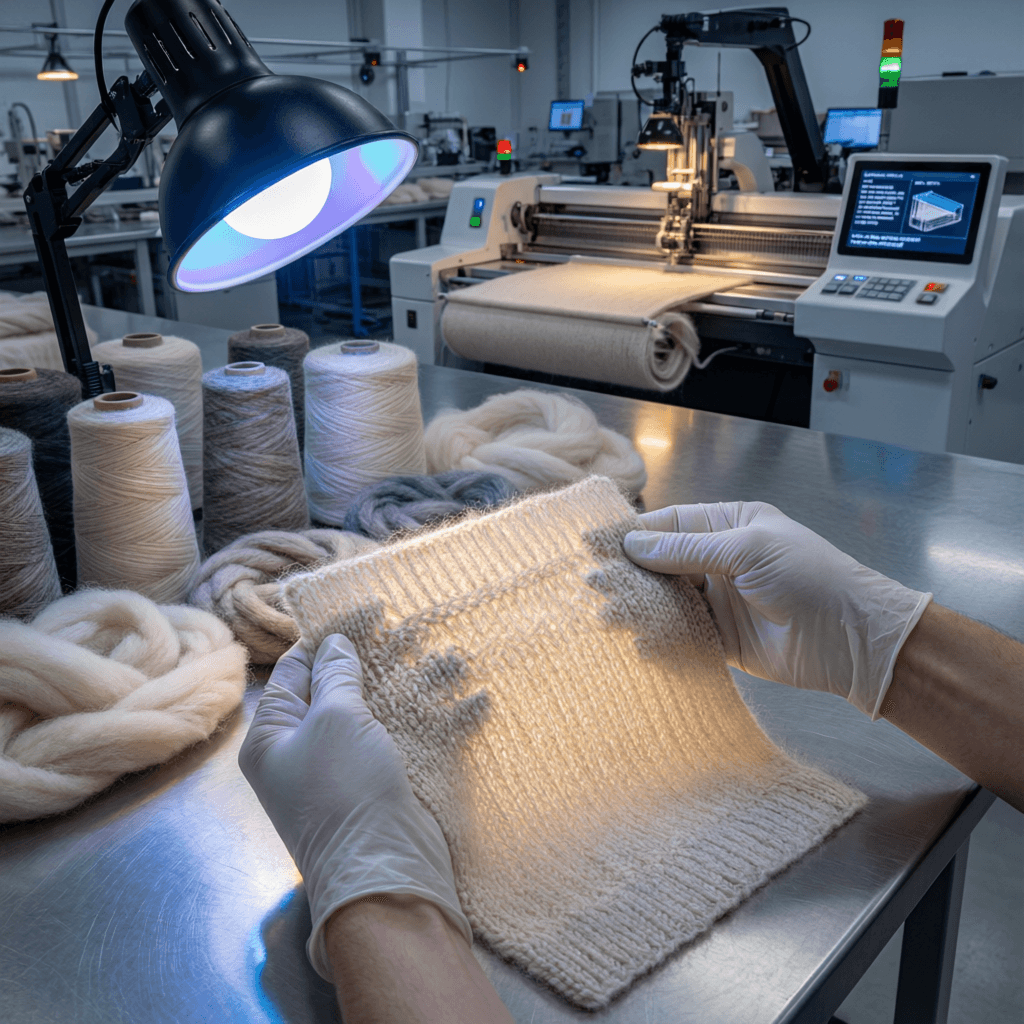
In high-volume knitwear and woven garment production, the most expensive defects are often invisible until the garment is washed or worn by the end consumer. A discrepancy of just one gauge point in sweater knitting can alter the hand-feel and drape significantly, leading to higher return rates. For instance, while a 3-5GG range creates chunky, structural pieces, midweight applications typically require 7-10GG to balance warmth with flexibility, whereas fine-gauge luxury items demand 12-18GG precision. Without automated tension monitoring, suppliers may inadvertently produce batches with inconsistent loop lengths, resulting in uneven shrinkage after laundering.
Leading manufacturers mitigate this by integrating inline inspection systems that verify stitch density against digital tech packs. When evaluating a partner, ask for their tolerance thresholds on gauge variation. A robust QC protocol ensures that a 12GG specification remains within a tight tolerance band across thousands of units, preventing the “barre” effect or horizontal striping common in poorly tensioned acrylic or wool blends.
(See our related guide: How to Scale Production without Sacrificing Quality.)
How Do Inspection Standards Compare When Benchmarking AQL 2.5 Against Retailer Specifics?
Acceptable Quality Limit (AQL) is the industry standard for defining the maximum number of defective units acceptable in a random sample. However, not all AQL levels are created equal, and relying on generic “industry standard” claims can be risky for premium brands. Most major retailers require an AQL 2.5 for major defects and 4.0 for minor defects during final random inspection. This statistical sampling method provides a confidence level that the entire batch meets quality expectations without inspecting every single piece.
| Inspection Parameter | Standard AQL 2.5 Protocol | Premium Brand Requirement | Impact on Production |
|---|---|---|---|
| Major Defects Limit | 2.5% of sample size | 1.5% – 2.0% of sample size | Higher rejection rate; requires stricter in-line QC |
| Minor Defects Limit | 4.0% of sample size | 2.5% – 3.0% of sample size | Increased labor for trimming and pressing |
| Sample Size Code | General Level II (ISO 2859-1) | Special Level S-3 or S-4 | Larger sample sizes increase inspection time |
| Critical Defects | Zero tolerance (0.0) | Zero tolerance (0.0) | Immediate batch rejection if found |
| Color Fastness Test | Grade 3-4 (ISO 105-C06) | Grade 4-5 (ISO 105-C06) | Requires higher-quality dyes and fixation agents |
| Dimensional Stability | ±5% after wash | ±3% after wash | Tighter control on knitting tension and finishing |
| Seam Strength | Minimum 60N force | Minimum 80N force | Requires adjusted stitch density and thread quality |
| Pilling Resistance | Grade 3 (Martindale) | Grade 4+ (Martindale) | Necessitates anti-pilling treatments or finer fibers |
Suppliers like Cogarm adhere to AQL 2.5 inspection standards as a baseline, but top-tier partners will customize these thresholds based on the specific risks of the fabric. For example, Merino wool blends may require stricter pilling tests compared to synthetic acrylics. By defining these metrics in the purchase order, buyers remove ambiguity and ensure that the supplier’s internal QC team is aligned with the brand’s retail expectations.
How Can Material Traceability and Color Accuracy Be Ensured in Blends?
Achieving color consistency in blended fabrics—such as Merino/Acrylic or Cotton blends—is one of the most challenging aspects of apparel production. Different fibers absorb dye at different rates, leading to potential shading issues if the blend ratio or dyeing process varies even slightly. Precision in color matching is non-negotiable; suppliers must utilize Pantone TCX matching systems to ensure that the physical sample matches the digital standard under various lighting conditions.
Read more about The Science Behind Dimensional for additional context.
Furthermore, sustainability certifications are no longer optional for many global markets. Integrating Global compliance standards such as OEKO-TEX, GOTS, GRS, and BSCI into the production workflow ensures that materials are free from harmful substances and ethically sourced. For instance, using GRS-certified recycled wool or GOTS organic cotton requires a documented Chain of Custody (CoC) from the yarn spinner to the final garment assembler. Buyers should request CoC documentation for any claimed sustainable material to verify compliance and avoid greenwashing risks.
How Can Dual-Base Manufacturing Be Leveraged for Agile QC?
Traditional supply chains often separate knitting and cut-and-sew operations across different regions, creating logistical bottlenecks and communication gaps that hinder quality control. A more resilient model involves dual-base manufacturing, where specialized processes are housed in proximate, specialized facilities. Cogarm’s dual-base model in Dongguan exemplifies this approach by utilizing Dalang for premium knitwear production and Humen for cut-and-sew operations. This geographic proximity allows for rapid feedback loops between knitting and assembly teams.
When a dimensional issue is identified in the sewing stage, the knitting team in Dalang can adjust tension or gauge parameters immediately, rather than waiting for weeks-long cross-border communications. This integration supports greater flexibility, such as accommodating MOQs of 100 pcs per color/style for knitwear, which is significantly lower than the industry average for custom apparel. Additionally, this streamlined workflow enables faster sample lead times of 15-20 days, allowing buyers to validate quality and fit before committing to full-scale production runs of 45-60 days.
— as detailed in our article on How to Prototype Technical Apparel Effectively.
What Should a Strategic Sourcing Checklist for Procurement Managers Include?
To effectively evaluate potential suppliers, procurement managers should use a structured checklist that goes beyond price per unit. Focus on the supplier’s ability to maintain consistency at scale and their transparency in reporting.
- Verify Inspection Protocols: Confirm that the supplier performs AQL 2.5 inspections internally before third-party audits. Request recent inspection reports to assess their defect categorization accuracy.
- Assess Color Management: Ask for their process for Pantone TCX matching. Do they use spectrophotometers? How do they handle metamerism in blended fabrics?
- Check Traceability Documentation: For any sustainable claims (GOTS, GRS), request the current Transaction Certificate (TC) and Chain of Custody documents.
- Evaluate Responsiveness: Test their sample lead time. A 15-20 day sample turnaround indicates a responsive supply chain capable of handling iterative design changes.
- Review Flexibility: Determine if they can accommodate smaller initial runs (e.g., 100 pcs MOQ) to test market response before scaling to larger volumes.
FAQ
What Are the Frequently Asked Questions?
What is the typical production lead time for custom knitwear after sample approval?
Production typically takes 45-60 days from sample approval, depending on order volume and yarn availability.
How does AQL 2.5 impact the cost of goods sold?
Adhering to AQL 2.5 may increase initial QC labor costs but significantly reduces the risk of costly chargebacks and returns due to defective merchandise.
For a deeper dive, see Managing Shrinkage in Technical Fabric Production.
Can suppliers accommodate small minimum order quantities for testing?
Yes, specialized manufacturers like Cogarm offer MOQ flexibility starting at 100 pcs per color/style for knitwear, allowing brands to test markets with lower risk.
Why is Pantone TCX matching critical for blended fabrics?
Pantone TCX matching ensures color consistency across different fiber types that absorb dye differently, preventing shading issues in the final garment.
What certifications should I look for in sustainable apparel sourcing?
Look for integrated global compliance standards such as OEKO-TEX, GOTS, GRS, and BSCI, and always verify with Chain of Custody documentation.
How Should a Supplier Evaluation Framework Be Finalized?
Effective quality control in large-scale apparel exports requires a partnership with suppliers who prioritize transparency, precision, and agility. By demanding data-driven insights—such as AQL 2.5 inspection reports, Pantone TCX color verification, and verified Chain of Custody documentation—buyers can mitigate risk and ensure product integrity. Evaluate potential partners not just on their capacity, but on their ability to integrate these protocols into their daily operations.
Request a marker efficiency simulation and a recent AQL 2.5 inspection report from any supplier you are evaluating to benchmark their operational transparency and quality commitment.
Image Attachment

How should buyers audit AQL 2.5 inspection and colour matching?
Audit the method, not the promise. Confirm the inspection plan follows ISO 2859-1 at AQL 2.5 with the sampling code stated per lot, that defects are classified major and minor, and that rejected lots cannot ship. For colour, require a physical standard per shade, Pantone references with a stated light source, and a colour measurement record rather than a visual opinion. Traceability should run from yarn lot to carton. Because gauge and tension drift show up only after laundering, add a wash test on the bulk lot. Confirm OEKO-TEX STANDARD 100 limit values on the finished article, keep GOTS chain of custody for organic cotton at 95% or more certified organic fibre, and use SGS or Intertek for third-party verification.
Frequently asked questions
What inspection standard should a buyer audit for?
AQL 2.5 under ISO 2859-1, with proper sampling codes and defect classification. The article also asks for recent inspection reports, traceability running from yarn lot through to the finished carton, and Chain of Custody documentation for sustainable material claims.
How should colour be controlled in a QC protocol?
With Pantone TCX standards, documented light sources and spectrophotometer measurements. The article treats colour as a measured gate alongside workmanship inspection and traceability, and a documented light source prevents disagreement between buyer and factory during approval.
Why is gauge and tension drift costly?
The post calls these the invisible defects, appearing only after washing or wear. A one-gauge discrepancy can alter hand-feel and drape significantly and raise return rates, so loop length should be monitored and recorded per batch.
Which gauge ranges does the article associate with which products?
A 3 to 5GG range is described as creating chunky, structural pieces, while midweight applications typically need 7 to 10GG to balance warmth and drape. The article links gauge choice directly to hand-feel and product category expectations.
Cogarm has manufactured custom knitwear and woven garments in Dongguan, Guangdong, China since 2006. Minimum order is 100 units per style and colourway.

[…] sample that shrinks 5% after washing, while the woven panel remains static, causing seam puckering. Read more about Quality Control Protocols for for additional […]