
Cargo Joggers Grey: The OEM Manufacturer’s Guide
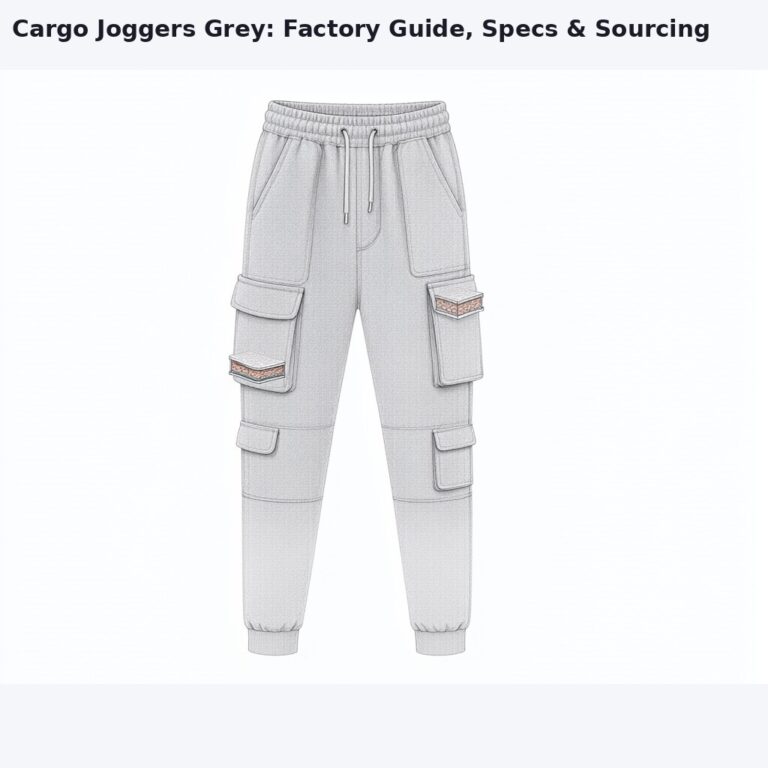
Quick answer: A grey marl cargo jogger lives or dies on four numbers: fabric weight of 280 to 320 gsm, 5 to 8 percent elastane in the waistband, a shrinkage lim
Helping procurement managers navigate the complexities of Chinese B2B garment trade.
Quick answer: A grey marl cargo jogger lives or dies on four numbers: fabric weight of 280 to 320 gsm, 5 to 8 percent elastane in the waistband, a shrinkage lim

Quick answer: The first products a clothing brand launches set its cash flow, factory relationships and learning curve. Buyers should start with styles their manufacturer already produces well, at quantities that limit dead stock, and with specifications simple enough to…

Quick answer: Quality disputes are won on documentation, not argument. Specify tolerances and test methods before production, inspect to AQL 2.5 under ISO 2859-1, classify defects as critical, major or minor, and open the claim inside the agreed window with…

Quick answer: The four standards buyers audit most often are GOTS for organic fibre content, GRS for recycled content, OEKO-TEX STANDARD 100 for chemical limits on the finished article, and amfori BSCI or WRAP for social performance. Each answers a…

Quick answer: Landed cost is the true cost of imported garments: FOB price plus freight, insurance, duties, taxes, customs clearance, port and inland handling, and any demurrage or inspection fees. Air freight trades cost for speed and is usually reserved…

Bulk apparel shipping costs are driven by volume and carton fill, not weight alone. Ocean FCL is cheapest per unit for large non-urgent orders exceeding roughly 5,000 units and 15 CBM, while air freight suits small or urgent runs despite…

Quick answer: A knitwear RFQ is priced from gauge, yarn count, fibre, fabric weight, colourways, size break and MOQ, not from a picture. For 12GG midweight you specify finer yarn and tighter tolerances than for 3GG chunky, and the machine…

Quick answer: Direct-to-factory sourcing buys traceability, technical control and a clearer cost breakdown; a trading agency buys convenience, consolidated logistics and smaller minimums. The right answer depends on order complexity and volume: complex knitwear with certification claims usually rewards direct…

Quick answer: Tech packs leak through convenience, not espionage. Share only what a supplier needs for the quoted operation, issue watermarked files with a version log, require a signed NDA with defined liability, and keep the full construction detail off…

Quick answer: Knit and woven lines differ in almost every planning input: yarn versus fabric, gauge versus loom width, linking versus sewing, and different shrinkage and inspection criteria. Running both in one factory works when the two flows have separate…
Minimum order quantity for Supply Chain & Sourcing is 100 units per style and colourway. Larger programmes unlock better unit pricing, and trial runs can be discussed for first orders. Tell us your target quantity and delivery date for a firm quote.
Yes. OEM and ODM production is our core business. Our in-house pattern room turns your tech pack or reference sample into a graded production package, with custom labels, logo embroidery or printing, hangtags and retail packaging.
Fabrics are sourced from OEKO-TEX certified mills, production runs in WRAP-certified factories, and the quality system is ISO 9001 certified. Test reports and certificates are shared with approved buyers on request.
Send your brief, target quantity and delivery date. We quote within two working days, develop the proto-sample in 7-10 days, and move to bulk after you approve it. A merchandiser follows the order from sampling to shipment.